Discontinued Japanese 100 V appliance; owner/import reference rather than US120 V buying recommendation.
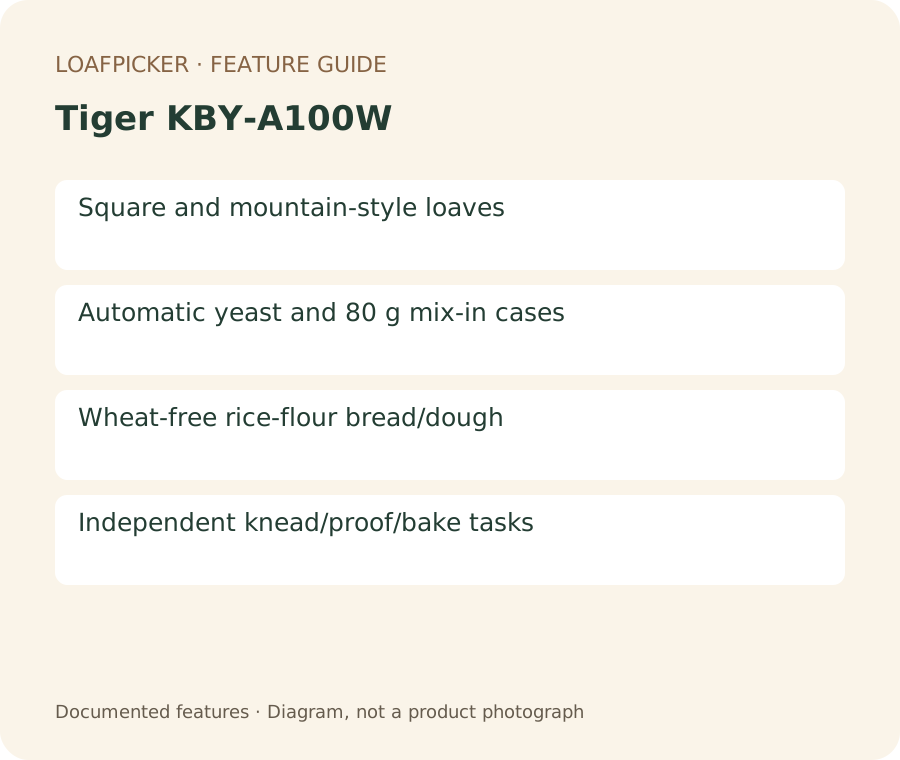 Original LoafPicker feature diagram. Product references appear below. Not a product photograph.
THE FIT AT A GLANCE
At a glance
A Japanese-power owner seeking the documented lidded square-loaf routine or separate process tasks.
Discontinued 100 V model; square breads need manual work and cannot use reservation or automatic mix-ins.
Shop this model on Amazon ↗Affiliate link · Model search.
The KBY-A100W is best understood through the difference between its mountain-style and square loaves. The square preparation uses a special lid and includes a manual work period. The mountain-style bread follows a different routine. Both belong to a Japanese 1斤 machine; no exact pound-size selector has been established. A buyer interested specifically in square sandwich bread should examine the required handling and included lid, not just the photograph of the finished shape.
Tiger marks the model discontinued. Its exact manual says it is designed for Japanese AC 100 V, 50–60 Hz use and excludes foreign supplies with different voltage or frequency and overseas service. This is an owner or import reference, not an ordinary US 120 V recommendation. The physical rating label, condition, and accessory set decide whether an individual unit can serve the documented purpose.
Square bread changes the workflow
Tiger documents both a lidded square loaf and an open-top mountain loaf on its manufacturer product page. The exact KBY-A manual provides the more important operating distinctions. The standard square course takes about three hours and 50 minutes including a 35-minute manual work period. The chart excludes reservation and automatic mix-in dispensing for the square bread courses.
That matters for a household wanting sandwich-shaped bread ready unattended at breakfast. The shape may suit the intended slices, but its course is not simply the standard mountain-loaf program with a lid added. A complete used unit needs the correct square-bread lid, pan, and related parts. A listing that includes only the main body and a generic paddle does not demonstrate that this preparation can be followed.
Ordinary bread takes about three hours and 30 minutes; rapid bread takes around one hour and 50 minutes. The flour-input table on page 70 also separates the recipes: standard bread uses 250 g flour, rapid and square breads 280 g, brioche-style bread 240 g, and cooked-rice bread 220 g. These are prescribed ingredient quantities, not finished loaf weights or permission to scale every course to a common maximum.
Two automatic cases, with an 80 g addition limit
The machine includes automatic yeast release and an automatic ingredient case. The ingredient limit is 80 g, which is lower than the 100 g combined case in the Japanese Panasonic models considered here. Dry fruit and nuts need appropriate chopping; suitable additions are dry and resistant to melting. Sugar-coated fruit, alcohol-soaked fruit, cheese, chocolate chips, vegetables, ham, bacon, and sausage require the hand-addition route. Small sesame is loaded initially within the specified flour-relative limit.
Manual addition has its own scheduling consequence. Selecting the manual mix mode disables reservation, and the baker must add ingredients within the stated buzzer interval. A cheese loaf and an automatic dry-raisin loaf therefore have different unattended potential. Edamame and olives also have reservation restrictions because they are perishable. The dispenser case should not be valued as a universal hopper that bypasses recipe rules.
The accessory list distinguishes a bread blade from a noodle/mochi blade. The second blade does not establish simultaneous dual-paddle bread kneading. Check that the blade needed for the intended recipe is included rather than treating the number of loose accessories as a sign of larger bread capacity.
The wheat-free course has a timer tradeoff
Menu 11 makes wheat-free rice-flour bread using 300 g of the specified こめの香 gluten-free mix. In immediate preparation, a buzzer approximately 13 minutes after starting calls for scraping flour from the pan within five minutes. The program then continues. It has no automatic mix-in option and no crust-color selection. Its supported recipe is more specific than a general claim that the machine accepts any gluten-free flour.
Reservation is available for this course, but the manual says the flour-scraping task is omitted when the timer is used. Flour can consequently remain on the bread's surface. This is a genuine decision between a delayed finish and the immediate course's manual intervention, not an inconsistency to conceal. The GF timer's shortest completion interval is two hours, compared with an immediate course time of about one hour and 50 minutes.
Tiger also lists a wheat-free rice-flour dough course. Neither that program nor the bread recipe establishes cross-contact protection. The manufacturer cautions highly wheat- or gluten-sensitive users to consult a clinician. The state of a used machine and its previous wheat use remain relevant to that assessment.
Choose crust and delay by course number
The three crust levels are available only on specified courses. Ordinary, aged, rapid, soft, rich, French, and cooked-rice breads allow selection, along with the square breads, standalone Bake, and Cake. Brioche-style, rye, whole-wheat, and wheat-free rice-flour bread do not. A preference for a pale whole-wheat crust cannot be solved by assuming that the machine's crust button works everywhere.
Reservation extends to 13 hours for menus 1, 2, 4, 7, 8, 9, 10, and 11. It excludes rapid, rich, brioche-style, square, dough, independent-stage, and specialty courses. Milk, eggs, juice, and vegetables further restrict delayed recipes. The standard bread instructions document 60 minutes of keep-warm, but prompt removal is advised to limit additional browning.
Separate process tasks and the practical comparison
Tiger supplies standalone kneading for 1–25 minutes, two proofing tasks adjustable from five minutes to five hours, and baking for 5–45 minutes. These support an owner who will inspect dough and choose the next task. They do not establish saved complete custom cycles. The 27 food menus exclude the additional pan-cleaning menu numbered 28.
The body measures about 22.9 cm wide, 30.9 cm deep, and 32.3 cm high, weighing approximately 6.8 kg. It is narrower than the SD-MT4, but that alone does not settle space for loading and lid handling. The Panasonic alternative offers a 100 g addition case and its own half-loaf recipe; the Tiger's distinct reason for consideration is the documented square-loaf preparation and its particular independent tasks. Keep the voltage restriction first, then decide whether those concrete workflows justify choosing a discontinued unit.
Documented specifications
- Model
- KBY-A100W
- General loaf sizes
- 1斤
- Dedicated GF course
- Yes
- GF capacity basis
- Menu 11 one Japanese 1斤 wheat-free recipe uses 300 g specified GF mix; no pound or GF size selector.
- Automatic add-ins
- Yes
- Complete adjustable cycle
- Not confirmed
- Body dimensions
- 9.0157 × 12.1654 × 12.7165 in (W × D × H)