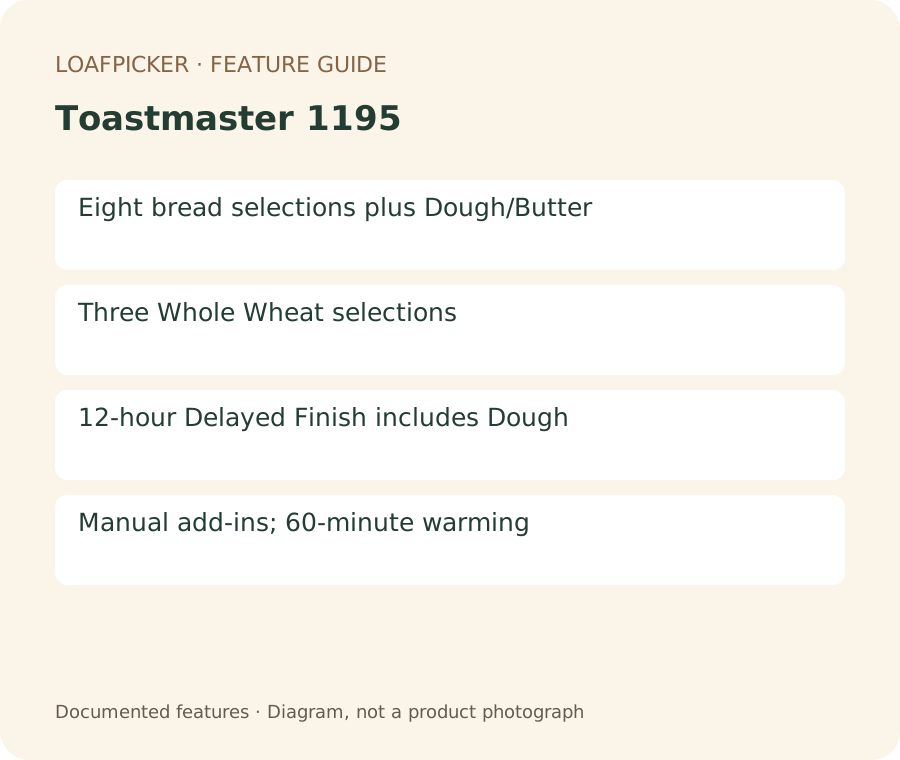
 Original LoafPicker feature diagram. Product references appear below. Not a product photograph.
THE FIT AT A GLANCE
At a glance
Conventional and Whole Wheat preset choices, with explicitly delayed Dough for later shaping and oven baking.
Recipebooknotrecovered; size claims are recipe capacities, not independently selectable controls.
Shop this model on Amazon ↗Affiliate link · Model search.
The Toastmaster 1195 is best understood through its actual control panel rather than a compressed list of retailer specifications. Its booklet names three loaf sizes, but the verified panel has no separate loaf-size button. It offers eight bread selections plus Dough and Butter Churn, with several of those selections dedicated to crust or whole-wheat differences. That makes it a useful legacy machine to identify carefully, particularly if an owner wants scheduled dough preparation. This is a documentation-based review, without a fresh bake test or claims about current retail availability.
The control panel resolves an important ambiguity
The retained guide’s “Major Features” section names one-, one-and-a-half- and two-pound loaves. Those are recipe-capacity statements. The panel diagram shows timer arrows, Select, Start and Stop. It does not show an independent size selector. A buyer should therefore avoid comparing this model as though it supplies three separately timed size positions for every course. The chosen recipe and named setting are the operative combination.
The verified panel lists Basic Light, Basic Medium, Basic Dark, Whole Wheat Light, Whole Wheat Medium, Whole Wheat Rapid, French, Sweet, Dough and Butter Churn. This also clarifies the phrase “eight bread settings”: several are variations within Basic or Whole Wheat rather than eight unrelated kinds of bread. Compare that exact sequence with an offered machine. A model number copied into a listing is weaker evidence than a matching panel and readable underside label. The source is the retained Toastmaster 1195 Use and Care Guide.
Whole Wheat is a genuine part of the design
The separate Whole Wheat choices are useful evidence for someone whose regular loaf uses that flour. They show that the machine’s bread selection is not limited to a general white-bread sequence. The Rapid name still needs a corresponding formula: it does not authorize putting any slow whole-wheat recipe on the shorter option and expecting the same result. Ingredients, hydration and leavening must be matched to the intended process.
The recovered use-and-care file refers to an accompanying recipe book, but a complete exact 1195 recipe book was not established in this assessment. That is a meaningful gap for a new owner. Operating controls can be clear while the preferred starting formula is still missing. Ask for the original recipe packet with the machine or obtain label-matched guidance before adapting another model’s quantities. Its two-pound maximum should be treated as a limit rather than a target for every flour combination.
Delayed Dough is explicitly documented
The manual has a section covering delayed completion for both bread and Dough, up to twelve hours. Dough is setting 9, and its instructions say to remove the mixture when the course ends. That could suit an owner who wants the initial mixing and rise ready for an evening session of shaping and oven baking. The timing benefit is concrete: the machine can finish its preparation stage near the time you are ready to take over.
The owner must still be there. The booklet warns against letting finished dough remain in the machine, where continued rising can cause trouble. The timer also excludes recipes containing perishables such as eggs, fresh milk or cheese. A dough formula that uses those ingredients does not become suitable for a long wait merely because the Dough course accepts a timer setting. Plan the whole handoff from ingredients to removal, shaping and baking before relying on delayed preparation.
Automatic baking does not include automatic mix-ins
The booklet describes an additional-ingredient buzzer, which asks the user to add ingredients manually. No automatic dry fruit-and-nut release compartment is documented. That distinction matters if an unattended raisin loaf is the intended purchase use. An alert is helpful when someone is within hearing distance and ready to act; it cannot open a container or decide how much fruit to add. The exact recipe should determine when additions are appropriate.
Nor does Dough establish a saved custom cycle or independently adjustable fermentation temperature. The verified course list lacks a dedicated Gluten-Free program, and this assessment did not recover an exact GF recipe. These are limits to the documented recommendation, not a claim that adaptation is impossible. Buyers requiring supported gluten-free bread or flexible natural-starter fermentation should ask for the missing exact-model evidence before treating the 1195 as a match.
Butter Churn and condition affect second-hand value
Butter Churn is a separate named function for working cream, not another baked-bread course. Check that the unit includes the required original components and instructions if this feature is a reason for buying. A photograph of an exterior in good condition is not enough to establish that the pan, paddle and any specialised pieces are present or compatible. Those parts affect whether a bargain machine can carry out the work that attracted you.
The operating directions specify a 120 V, 60 Hz AC outlet. The pan is removed by lifting straight up, and the guide emphasises careful treatment of the pan and nonstick interior. Use those details to ask useful condition questions rather than assuming every Toastmaster pan fits. The sixty-minute warming period after bread baking is a convenience window, not a long-term storage method. Historical warranty language and contact details do not prove current service eligibility.
The 1195 has a credible owner-reference role for conventional and whole-wheat bread, particularly when delayed Dough is useful. Its control panel is now sufficiently clear to avoid inventing a three-position size selector. The remaining buying checks are the exact label, complete components, condition and access to a suitable original recipe packet. For a buyer focused on specialty diets, automatic additions or custom fermentation, those documented gaps should carry more weight than the largest nominal loaf size.
Documented specifications
- Model
- 1195
- General loaf sizes
- 1 lb, 1.5 lb, 2 lb
- Dedicated GF course
- No
- GF capacity basis
- Verified panel lacks dedicatedGF; exactGFrecipe not recovered.
- Automatic add-ins
- No
- Complete adjustable cycle
- No
- Body dimensions
- Not confirmed in the primary sources used here