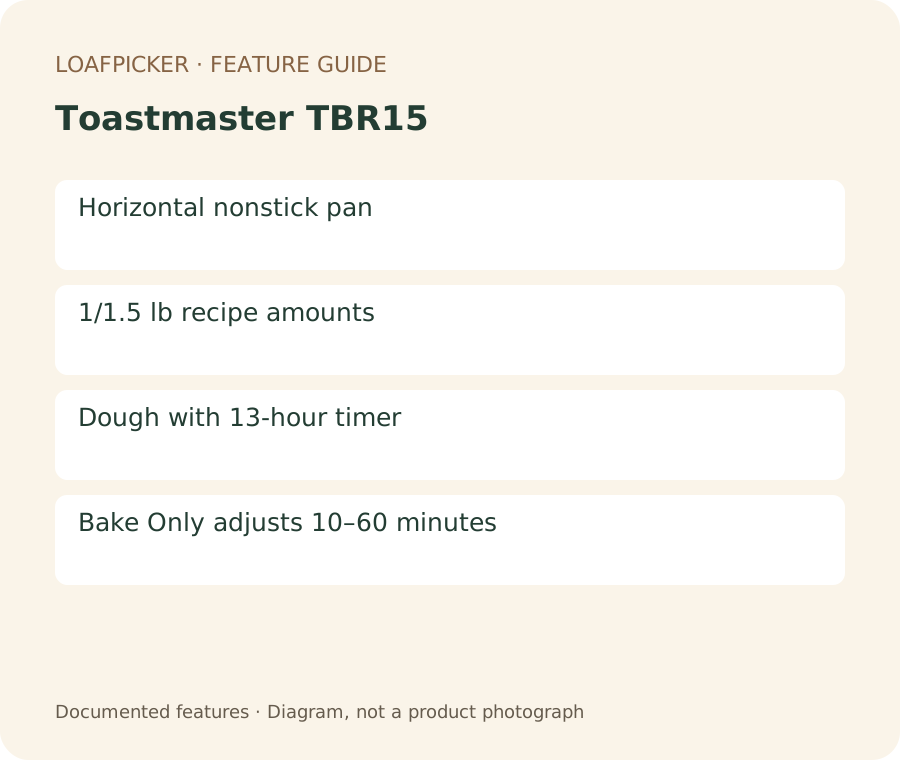
 Original LoafPicker feature diagram. Product references appear below. Not a product photograph.
THE FIT AT A GLANCE
At a glance
Modest conventional batches and a planned Dough handoff for oven finishing.
No independent weight selector, GF recipe, automatic additions or adjustable proof stage established.
Shop this model on Amazon ↗Affiliate link · Model search.
The TBR15 is a useful legacy option to identify when a two-pound machine feels excessive and a horizontal pan is appealing. Toastmaster’s retained booklet describes a maximum one-and-a-half-pound loaf, includes smaller recipe quantities and gives eight preset courses. Its most practical scheduling detail is that Dough can use the thirteen-hour completion timer. That feature needs to be distinguished from Fast Bake, which cannot be delayed. This review follows the documented TBR15 workflow and does not claim a new bake test, current sales offer or measured countertop footprint.
Match TBR15 and its regional suffix
The manufacturer-era Use and Care Guide covers TBR15 and TBR15CAN. Their shared bread instructions do not remove the need to inspect the particular unit’s plug and electrical label. Check the complete suffix rather than selecting a regional replacement part from an abbreviated listing. The retained cover and back page describe the one-and-a-half-pound machine and horizontal nonstick pan. A similarly named larger Toastmaster should not supply its capacity, recipe quantities or timing rules.
The original TBR15/TBR15CAN guide also provides a panel diagram. It has program and crust controls, but no separate loaf-size button. The presence of one- and one-and-a-half-pound recipes is therefore not evidence of two selectable size positions. That distinction is useful if you are comparing machines primarily by small-loaf automation: the recipe amount may change while the selected program still follows its documented sequence.
Choose its capacity around how much bread you use
A smaller maximum can be an advantage for a household that prefers baking more often or has little interest in freezing a large loaf. It can also be limiting when bread is needed for several people at once. Think through normal consumption before valuing a larger capacity elsewhere. The pan’s horizontal description may suit conventional slicing preferences, but the documentation does not establish exact finished slice measurements for every formula. Recipe composition and rise still affect the shape.
The named courses are Basic, French, Whole Wheat, Sweet, Fast Bake, Quick Bread, Dough and Bake Only. Basic has conventional crust choices. Quick Bread is described for baking-powder or baking-soda mixtures; it is different from the rapid yeast-bread course. Use each recipe with the process it names. A long menu comparison can obscure this simple question: does the machine have a documented method for the loaf or dough you expect to make repeatedly?
Fast Bake is a particular one-and-a-half-pound process
The Fast Bake entry is explicitly one-and-a-half pounds and approximately 58 minutes. It has its own recipe instructions, and its timer field is unavailable. Someone buying because of that headline should account for ingredient preparation and cooling as well as the machine’s runtime. It is not a promise that any small recipe can become a cooled breakfast loaf in less than an hour. The rapid method uses its own ingredient and liquid-temperature approach.
The guide gives a manual addition or checking signal on eligible courses, including Fast Bake. There is no automatic fruit-and-nut compartment documented. If you want to keep additions intact and add them later, attendance matters. If your routine demands complete absence after loading, inspect the exact recipe’s method before assuming the machine can handle the task unattended. The difference between a beep and an actual dispenser is more important here than the number of programs.
Delayed Dough is the useful scheduling feature
The program table explicitly permits the thirteen-hour timer on Dough, whose normal preparation time is approximately one hour and twenty minutes. Basic, Whole Wheat, French and Sweet are also listed as eligible. Fast Bake, Quick Bread and Bake Only are not. The completion timer includes the selected process; it is not thirteen hours of waiting followed by an additional entire cycle. Those distinctions let an owner plan an evening dough handoff more accurately.
Dough ends before final shaping and conventional oven baking. It has no automatic ingredient-addition alert in the documented eligibility list, so special additions need a recipe-specific manual plan. Delay also requires suitable ingredients: mixtures containing perishables must not wait through the timer. Arrange the finish around a time when you can remove the dough and carry on. The machine can schedule its preparation sequence but cannot decide whether your dough has risen enough for the next step.
What it does not document
There is no dedicated Gluten-Free course in the eight-program list and no exact TBR15 GF recipe established here. Quick Bread should not be relabelled as Gluten-Free simply because some gluten-free mixtures use chemical leavening. Bake Only adjusts heating in ten-minute increments, but that does not establish an independent adjustable proofing stage, custom saved program or fermentation-temperature control. Natural-starter preparation therefore remains a method an owner would need to substantiate, rather than a supported purchase claim.
The guide documents ten-minute power-interruption memory with qualifications about the course and recipe state. It should not be expanded into a guarantee that bread can always be rescued after an outage. Warming lasts up to an hour after the relevant baking courses. These are useful operating details for an owner; they are not substitutes for checking the physical condition of a machine that has been stored for years.
A complete unit is more valuable than a long feature list
The original parts list identifies pan 21930 and paddle 21495. Those are historical identification leads, not confirmation that replacements are in stock today. Check the offered pan’s locking fit, blade and nonstick surface, and ask a supplier to confirm compatibility before ordering. The original service addresses also do not establish a present warranty. With those checks satisfied, TBR15’s strongest case is modest conventional batches and scheduled oven-finished dough. Buyers seeking verified GF recipes, automatic dry additions or adjustable proofing should obtain stronger model-specific evidence before choosing it for those jobs.
Documented specifications
- Model
- TBR15
- General loaf sizes
- 1 lb, 1.5 lb
- Dedicated GF course
- No
- GF capacity basis
- The original TBR15/TBR15CAN guide establishes no dedicated gluten-free program or exact gluten-free recipe capacity.
- Automatic add-ins
- No
- Complete adjustable cycle
- No
- Body dimensions
- Not confirmed in the primary sources used here