Japanese domestic AC 100 V model; no manufacturer-supported US 120 V compatibility. Retained as a complete owner reference.
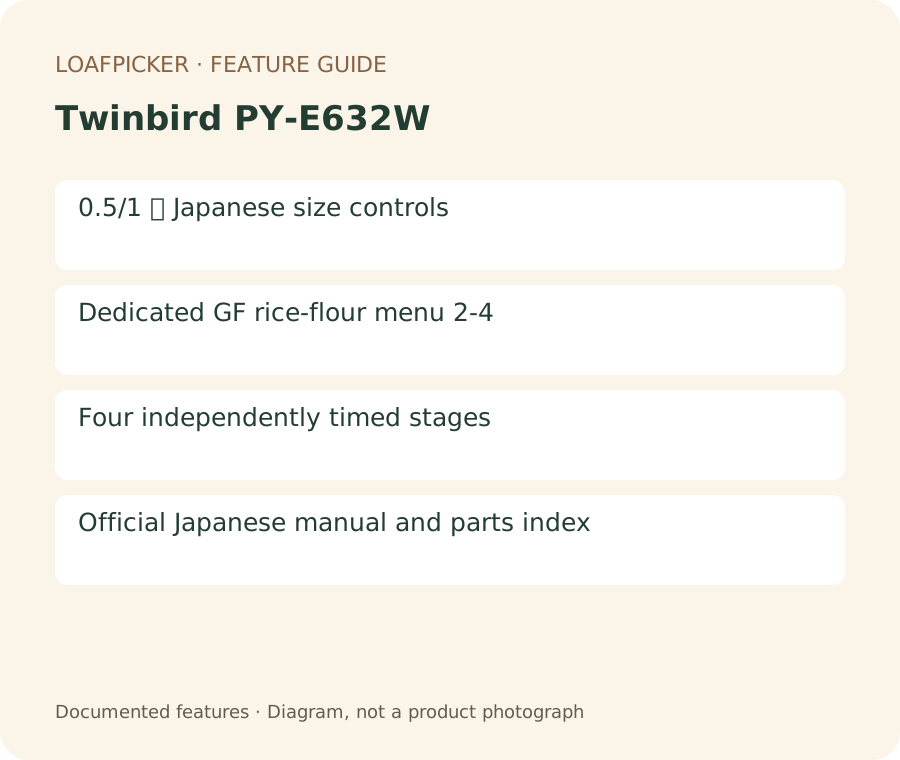 Original LoafPicker feature diagram. Product references appear below. Not a product photograph.
THE FIT AT A GLANCE
At a glance
Owner reference for Japanese-size conventional or GF rice-flour recipes and supervised independent stages.
100 V region excludes US matching; maker explicitly rejects natural yeast despite independent fermentation controls.
Shop this model on Amazon ↗Affiliate link · Model search.
The PY-E632W has unusually detailed original documentation for small Japanese bread sizes, rice-flour bread and separately timed preparation stages. Its most important purchasing boundary comes first: Twinbird specifies AC 100 V, not compatibility with a US 120 V supply. This entry is therefore an owner and identification reference for that regional model. Its Japanese size labels also remain in their original units. None of the evidence justifies converting the controls into familiar one- or two-pound positions to make the machine appear interchangeable with a North American breadmaker.
A clear model, with regional limits
Twinbird’s official store names the white PY-E632W and marks it discontinued. Its family manual is PY-E632. The manufacturer specifies 100 V at 50/60 Hz, with a 400 W heater and 30 W motor. Verify those details against the actual label on an imported or second-hand example. A matching plug shape would not by itself settle the electrical question, and this review does not recommend a power-conversion arrangement.
The maker gives dimensions in width/depth/height order: approximately 235 by 300 by 310 mm. That is roughly 9.25 by 11.81 by 12.20 inches, before allowing working clearance. Capacity is described as 0.5 and 1 斤. Those are the machine’s Japanese bread-size settings, not 0.5 and 1 lb selectors. The official product page and its linked instructions are the appropriate references when identifying the model.
Two rice-flour menus must not be confused
The manual separates ordinary Rice-Flour Bread from Rice-Flour Bread (Gluten-Free). The former uses a rice mix that includes wheat gluten; the latter is menu 2-4 and specifies a different gluten-free rice-flour mix. That distinction is more valuable than a broad rice-bread claim. Choosing the wrong mix or menu would change what is being prepared. The dedicated GF recipe lists both 0.5 and 1 斤 quantities, with size-dependent timing and mixing checks.
The GF instructions call for a mix containing guar gum and do not treat plain homemade rice flour as an equivalent substitution. They also explain that the mixture is wetter and that flour may need scraping from the corners at the signal. Follow the original ingredient specification rather than judging it by the firm dough expected from a wheat loaf. A named GF menu and a supplied recipe do not establish allergen separation or certification for an old machine that may previously have processed wheat.
The forty-mode count spans much more than bread
Forty modes include bread families, doughs, noodles, sweets, other foods and four independent stages. The number is not forty different automatic loaves. Main and submenus select the specific process, so the full menu code matters when asking for help. A photograph showing “rice bread” or a translated list without the submenu number may omit the distinction needed to choose the correct instructions.
Its range includes hand-finished bread doughs, noodle preparations, cakes and other foods that use different accessories or quantities. The original bundle lists a metal cover, fermentation container, its lid and a stand among the accessories. If a specialty food is the reason for acquiring a used machine, check that the relevant pieces remain with it. A bread pan and blade alone do not establish a complete bundle for every listed menu.
Independent stages do not imply approved natural-starter bread
Menus 7-1 through 7-4 separately run kneading, fermentation, final proof and baking, with adjustable duration. The manual gives examples involving hand shaping and switching stages. It also bounds the flour amount for this work, so the independent controls are not permission to mix any batch that happens to fit in the pan. These functions can help an attentive owner divide a yeast-bread process into manageable steps.
There is a critical qualification: the manual’s questions section and the manufacturer’s current family FAQ say natural yeast is unsuitable, citing variable starter condition and the longer fermentation it needs. I would therefore not recommend the PY-E632W as a documented natural-starter machine merely because it has fermentation buttons. The independent stages are real; the manufacturer’s restriction is real too. A supposed custom sourdough claim should not be built by ignoring that restriction.
Timer eligibility and manual additions
The completion timer reaches thirteen hours on the bread families in main menus 1 and 2. The GF page explicitly marks its timer usable. Dough, noodles, sweets, other foods and independent stages are excluded. Ingredient restrictions still apply, including formulas with refrigerated perishables. The timer describes when the selected course finishes; it does not create an unlimited waiting period for every recipe.
Twinbird’s family support FAQ confirms there is no automatic dispenser. Applicable courses signal for manual additions, and add-in bread cannot be scheduled through the timer as an unattended process. The same FAQ distinguishes the independent bread-kneading function from the harder noodle doughs: use the appropriate dedicated noodle process rather than putting every dough into Knead.
What an owner should obtain before use
Keep the official Japanese manual, the exact label and a complete accessory inventory together. Twinbird has an exact-family parts page, but a listed part is not a verified promise of stock or export support. The outage wording is also inconsistent at exactly five minutes, so it should not become a precise guaranteed recovery boundary. For a correctly supplied regional unit, the useful strengths are detailed small-size recipes and supervised stage control. For the US finder, the electrical rating remains a firm reason to retain it as a reference.
Documented specifications
- Model
- PY-E632W
- General loaf sizes
- 0.5 斤 / 1 斤
- Dedicated GF course
- Yes
- GF capacity basis
- Official manual menu 2-4 supplies both Japanese-size recipes and size-specific timing. No maker pound conversion or pound selector established.
- Automatic add-ins
- No
- Complete adjustable cycle
- No
- Body dimensions
- 9.25 × 11.81 × 12.2 in (W × D × H)