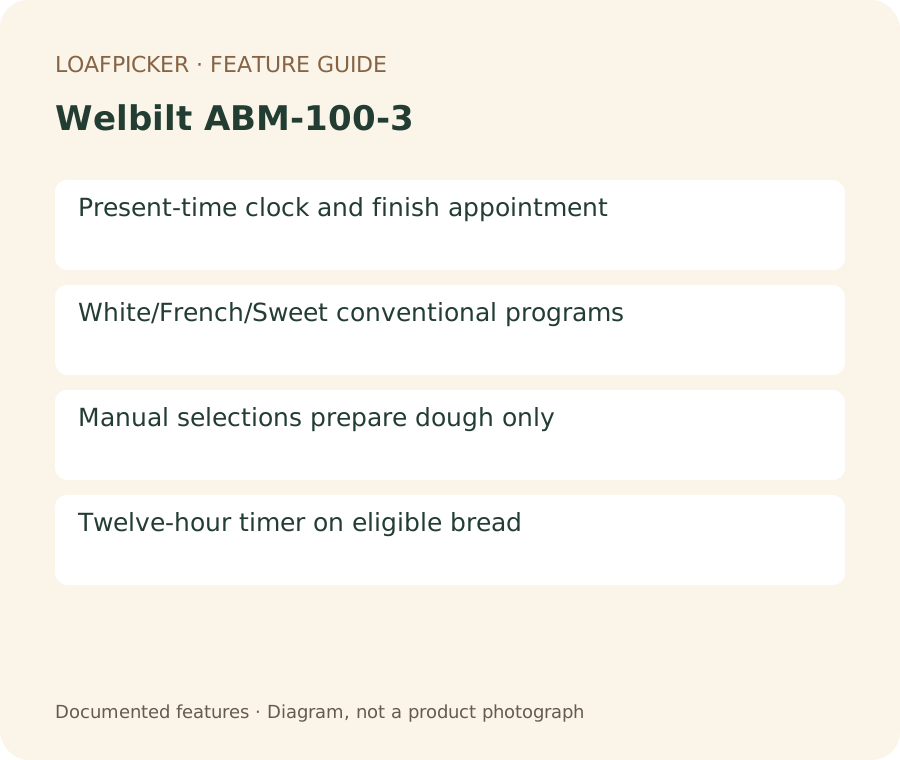
 Original LoafPicker feature diagram. Product references appear below. Not a product photograph.
THE FIT AT A GLANCE
At a glance
Owner reference for its present-time clock, conventional bread and later oven-finished dough.
Exact pound capacity and separate size controls unestablished; Manual means dough, not a stage editor.
Shop this model on Amazon ↗Affiliate link · Model search.
The ABM-100-3 is an older Welbilt whose usefulness depends on following a rather different operating routine from many current breadmakers. Its timer works with a clock showing the present time, and its named bread choices are White, French and Sweet, with corresponding dough-only Manual selections. Those are understandable controls once the exact instructions are available. The recovered owner's guide does not establish an exact pound capacity or a separate size selector. This review is therefore deliberately specific about its documented workflow and the information still missing.
Start with the model plate and original guide
Check that the label says ABM-100-3, including the final digit. Searches often return the similar ABM-100-4, other Welbilt models and inconsistent capacity descriptions. A photograph of a dome-shaped lid is not enough to settle the model or recipe quantity. The retained ABM-100-3 owner's manual identifies this version and shows its clock, program lights and inner-pot arrangement. Its separate baking-guide reference should not be replaced casually with recipes for a larger Welbilt.
The specification text gives AC 120 V at 60 Hz and a 750 W heater. It also contains dimensional fractions that were not resolved reliably from the transcription, so exact width/depth/height is not assigned here. Measure the actual unit and its lid clearance if counter space matters. Equally, do not convert an uncertain capacity claim from a used listing into a recipe limit. Obtain the original recipe guidance or a manufacturer-authenticated equivalent before choosing batch quantities.
The timer is an appointment on a clock
The guide first asks the owner to set the current hour and minute, including AM or PM. The later timer procedure sets when baking should finish. This differs from a simple display that always shows an interval such as ten hours from now. Before relying on an overnight loaf, practise identifying the present-time display and the programmed finish indication. A clock set twelve hours out can undermine an otherwise carefully measured recipe.
The timer permits a finish within twelve hours and changes in ten-minute increments. The guide gives a minimum scheduling interval of about four hours forty minutes. Those limits should be understood as part of the documented timing routine, rather than interpreted as twelve hours of waiting followed by an additional entire bake. Check the exact selected program and display before pressing the controls. A short familiarisation run is more informative than assuming the old interface behaves like a newer appliance.
Recipe ingredients determine whether delay is useful
The original guide excludes delayed recipes containing easily spoiled ingredients and also names absorbent ingredients such as oatmeal. That matters when choosing a breakfast formula: the presence of a timer does not make every milk, egg or grain recipe appropriate for overnight loading. Decide on the recipe first, then confirm that its ingredients and the manual’s timer procedure agree. The machine does not refrigerate a loaded mixture while it waits.
The model also uses an ingredient order that differs from common liquid-first instructions. Its directions put dry yeast first, followed by flour and the remaining ingredients, with lukewarm water last. Follow the exact recipe and model guidance rather than combining several brands’ loading habits. The point is not that one universal order is superior; it is that the retained process was written around a particular machine and formula.
Manual means dough preparation
The Manual indicator is paired with a bread type to prepare dough for later shaping, rising and oven baking. It is not a stage editor with freely chosen knead and proof durations. That makes the machine potentially useful for someone who enjoys rolls or shaped bread but wants help with initial mixing. It does not establish a documented long natural-starter process or independently adjustable fermentation temperature.
The three named full-bread choices likewise should not be expanded into a dedicated Whole Wheat or Gluten-Free program. A recipe containing some rye is not evidence of a separately controlled whole-grain course, and no exact GF recipe was established in the recovered guide. A buyer with either specialty requirement would be supplying missing validation themselves. The appropriate comparison is the actual named controls and available recipe support, not the breadth of breads mentioned in general promotional language.
Additions, cooling and interruptions
Optional ingredients are added by hand after a ten-beep signal near the end of the second kneading period. There is no documented automatic fruit-and-nut dispenser. A household planning an unattended raisin loaf therefore needs to consider whether the required attendance fits its schedule. The timer cannot physically add the fruit. The manual describes a later fan-assisted cooling period of approximately twenty to thirty minutes; that is different from a promised extended warm-hold cycle.
A power interruption ends the programmed process in the retained directions, which call for a fresh start. The clock may return to a flashing initial display. Do not interpret a twelve-hour timer as interruption memory, or promise that an interrupted loaf will resume automatically. For a used unit, condition of the clock, program lights and controls matters as much as the heating element, because those parts govern the scheduling routine that makes the appliance useful.
The sensible ownership decision
Inspect the inner pot, blade, shaft packing, lid and cord, and check exact replacement compatibility before buying missing parts. The original warranty and service telephone are historical evidence, not confirmation of current support. An ABM-100-3 with complete instructions and sound components may still serve an owner who wants its conventional bread and dough routine. Its unresolved capacity, older clock interface and lack of documented specialty controls make it a machine to identify carefully rather than select from a generic two-pound listing.
Documented specifications
- Model
- ABM-100-3
- General loaf sizes
- Exact size settings not confirmed
- Dedicated GF course
- No
- GF capacity basis
- No dedicated GF course or authenticated exact GF recipe in recovered owner guide.
- Automatic add-ins
- No
- Complete adjustable cycle
- No
- Body dimensions
- Not confirmed in the primary sources used here