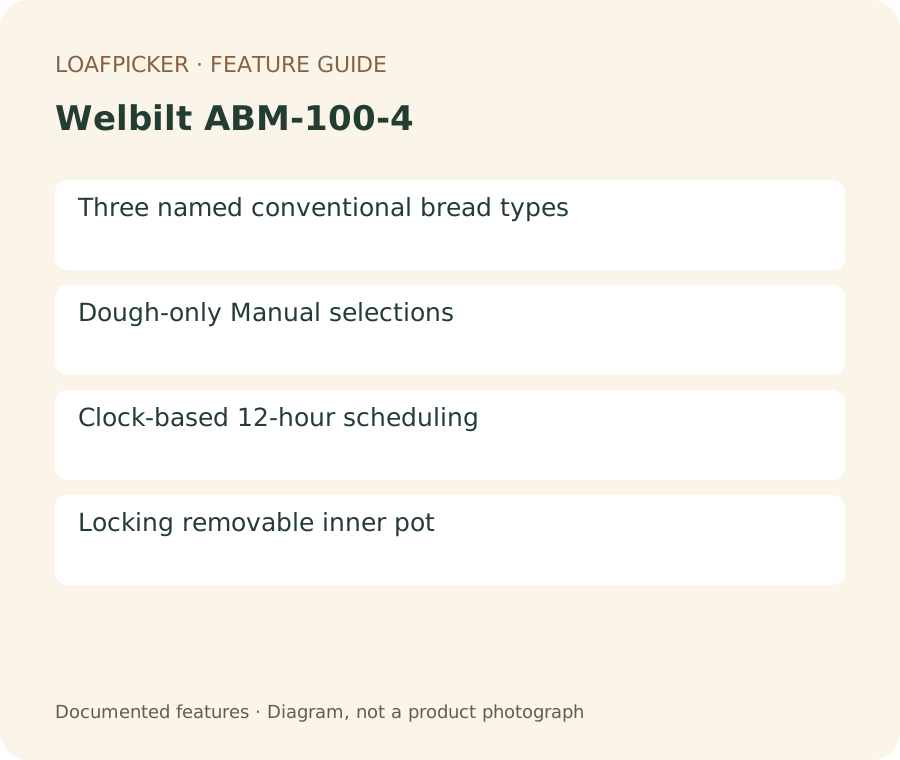
 Original LoafPicker feature diagram. Product references appear below. Not a product photograph.
THE FIT AT A GLANCE
At a glance
A complete identified unit for conventional recipes and owner-shaped dough, using its own guide.
Unverified pound capacity, old clock interface and no independently adjustable fermentation stages.
Shop this model on Amazon ↗Affiliate link · Model search.
The ABM-100-4 is a legacy Welbilt for owners who want a conventional bread cycle or dough to finish by hand. Its glass lid, locking inner pot and White, French and Sweet choices are documented in an original model-specific guide. What is not established there is an exact pound capacity or a set of selectable loaf sizes. An offered machine should therefore be judged first by its complete components, condition and accompanying recipe information. This review interprets the recovered instructions and does not report a hands-on test or current parts availability.
Keep the final model digit intact
The original owner's manual explicitly names ABM-100-4. The similar ABM-100-3 and later four-digit Welbilts appear in many searches, but their existence does not authenticate a replacement pan or recipe for this unit. Ask for the underside label, a complete panel photograph and a view of the pan mounting. A generic listing calling it a two-pound Welbilt is not enough evidence for choosing ingredient quantities.
The exact ABM-100-4 guide gives a 120 V, 60 Hz supply and a 750 W heater. It refers separately to a baking guide. Until the appropriate recipe guidance is available, do not infer the pan's supported batch from its apparent physical volume. Bread expands, and the usable quantity is more specific than how much material can initially fit inside the container.
A complete inner-pot assembly is essential
The instructions describe inserting the inner pot with its arrow facing forward and turning it clockwise to lock. The blade attaches to the drive shaft. Those details offer useful checks when inspecting a second-hand example: the pot should be the correct shape for the mounting and the blade should belong to that shaft. An item that merely rests inside the chamber is not necessarily a compatible pan.
The guide also identifies shaft packing and treats a problem with it as a service issue. A missing or unsuitable component can be more consequential than an exterior scratch, because mixing and liquid containment depend on the complete assembly. Before buying a machine without its original pot or paddle, obtain an exact part compatibility answer. This research does not establish that all ABM-100 series components interchange or that a present supplier stocks them.
The crust adjuster is not a fermentation temperature editor
The parts section describes a temperature-sensor adjuster marked toward darker or lighter baking. It provides a way to affect browning within the intended design. That should not be described as freely setting kneading, proofing and baking temperatures. No numerical temperature control or saved personal cycle is established by the recovered instructions. A shopper seeking fine control over long fermentation would need additional evidence.
Likewise, the Manual selections are dough-only processes paired with the bread types. The owner removes the dough, shapes it, allows the later rise and bakes in an oven. This can be useful if you enjoy handling rolls, bagels or other shapes while letting the machine perform initial work. It does not turn the ABM-100-4 into a fully programmable natural-starter system. The label on a button must be interpreted through what its instructions actually do.
The clock and recipe order need familiarisation
The interface uses a present-time clock and a programmed completion time. Set the current time, including AM and PM, before relying on a scheduled loaf. The timer is limited to twelve hours, advances in ten-minute steps and has a roughly four-hour-forty-minute minimum scheduling interval in the guide. These are operating rules to learn before expecting bread at a particular breakfast time, rather than reasons to assume the appliance is faulty when it rejects an unsuitable appointment.
Its loading method also deserves attention. The guide puts dry yeast first and lukewarm water last, following the model's recipe order. Importing a familiar liquid-first method from another machine would introduce a different process. Use the original recipe and loading guidance together, especially when ingredients will wait before mixing. The timer warnings exclude perishables and certain absorbent ingredients; it is not an overnight storage function for every formula.
Manual additions and a cooling phase
The documented secondary-kneading signal sounds ten times shortly before that stage ends, prompting manual additions such as raisins. There is no automatic fruit-and-nut compartment. That makes availability in the kitchen part of the recipe plan. An owner can appreciate the signal while still recognising that the machine will not pour additions on their behalf if nobody returns.
The instructions then describe fan-assisted cooling for approximately twenty to thirty minutes after baking. This should not be relabelled as an extended Keep Warm feature. They also prevent an immediate restart when the chamber remains too hot. If you intend to make consecutive batches, allow cooling and handling time rather than planning production solely from the nominal bread cycle. No noise or cooling-performance measurements were made for this review.
Who can make sensible use of it
A correctly identified, complete ABM-100-4 may suit an owner making conventional recipes and occasionally oven-finished dough. The guide does not establish dedicated Whole Wheat or Gluten-Free programs, exact GF recipes, independently timed proofing or outage recovery. Power loss interrupts its process and calls for starting again. The unresolved pound capacity and missing recipe support are meaningful purchasing checks, not details to fill from a nearby model. Verify the unit, pan, blade, shaft packing and recipe packet together before assigning value to an inexpensive used offer.
Documented specifications
- Model
- ABM-100-4
- General loaf sizes
- Exact size settings not confirmed
- Dedicated GF course
- No
- GF capacity basis
- No dedicated GF course or authenticated exact GF recipe in exact owner manual.
- Automatic add-ins
- No
- Complete adjustable cycle
- No
- Body dimensions
- Not confirmed in the primary sources used here