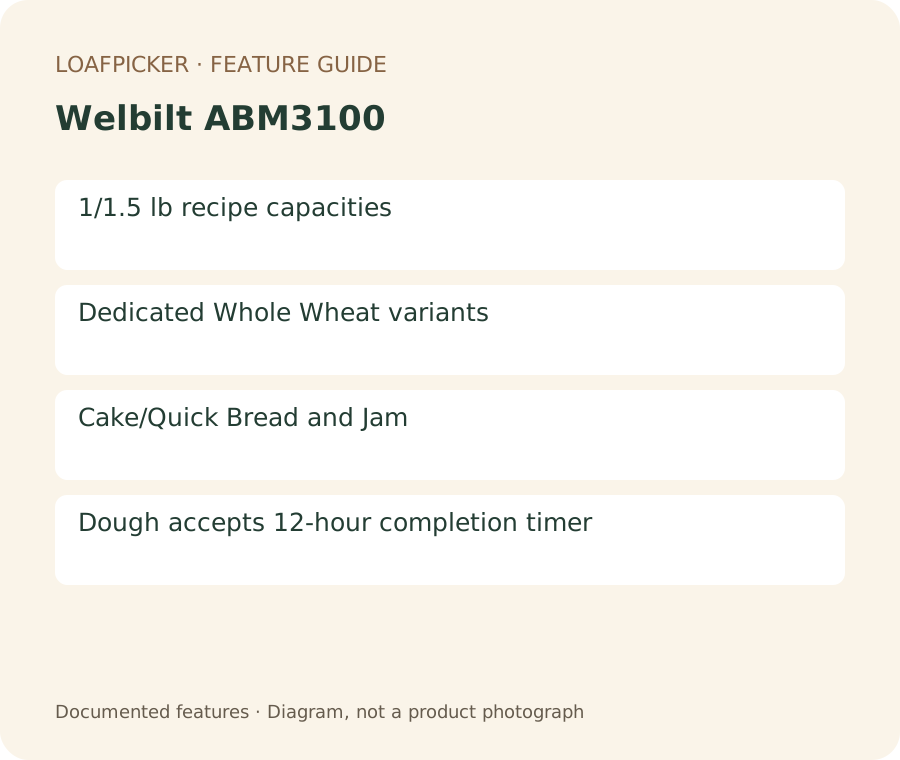
 Original LoafPicker feature diagram. Product references appear below. Not a product photograph.
THE FIT AT A GLANCE
At a glance
Smaller conventional recipe batches, dedicated Whole Wheat, Cake/Quick Bread, Jam and scheduled Dough.
Recipe sizes lack an independent selector; fixed programs and manual additions limit specialty automation.
Shop this model on Amazon ↗Affiliate link · Model search.
The ABM3100 is a legacy Welbilt with more everyday variety than a basic white-bread machine: dedicated Whole Wheat selections, French and Sweet bread, Dough, Cake/Quick Bread and Jam. Its documentation names one-pound Regular and one-and-a-half-pound Large loaves, but does not establish a separate size-selector button. That distinction matters when comparing its controls with newer machines. Its best case is a complete unit for smaller conventional batches and occasional hand finishing. This source-based review does not claim measured loaf quality, noise or current retail availability.
Recipe amounts are not separate size programs
The exact model's introduction and questions section identify Regular as one pound and Large as one-and-a-half pounds. The recovered panel shows settings selected by number, timer arrows, Start and Stop. It does not show an independent loaf-size control. Use the appropriate recipe amount with the setting it names; do not assume a separate size position changes every stage for you. That is a practical difference for someone who regularly switches batch quantities.
It can still be appealing to a household that uses modest amounts of bread and prefers baking more often to freezing most of a large loaf. Decide how much bread you normally finish before comparing maximum capacities. A smaller recipe does not automatically establish a smaller countertop footprint, however. Exact exterior dimensions in width/depth/height order were not verified here, so inspect the actual machine and lid clearance if space is tight.
Whole Wheat is a meaningful part of the menu
The eleven settings include three Basic crust choices and three Whole Wheat choices, followed by French, Sweet, Dough, Cake/Quick Bread and Jam. Whole Wheat includes an initial resting period, which means a stationary blade at the beginning need not indicate a fault. The flour or grain has time to absorb liquid before the later sequence. This is useful model-specific guidance for an owner encountering the machine without its booklet.
Whole Wheat Rapid is documented at approximately three hours twenty minutes. The word Rapid therefore means a shorter variant of that process, not a sub-hour yeast loaf. Choose it with its intended recipe rather than moving any slow whole-wheat formula to the shorter setting. The retained transcription also has a noisy table, so isolated unclear numerals should not override the readable setting descriptions without checking the original page.
Cake and Jam add different kinds of utility
Cake/Quick Bread is described for baking powder or baking soda mixtures and runs about one hour forty minutes. It is separate from rapid yeast bread. That distinction helps a buyer who makes banana loaves or other chemically leavened recipes choose the right workflow. A one-hour Jam setting is also listed, with a warning against doubling the recipe. Its presence does not establish canning or shelf-storage instructions for the resulting preserve.
Neither course establishes gluten-free support. The menu has no dedicated GF selection, and no authenticated exact-model GF recipe was recovered in this assessment. A recipe using a different flour cannot be assumed to work because the machine has a Cake course. A specialist buyer needs a validated formulation and process, rather than a feature count broad enough to imply every dietary requirement is covered.
Delayed Dough can fit an evening baking routine
The manual explicitly says its timer can prepare bread or dough while the owner is away. The completion limit is twelve hours including the chosen setting, adjusted in ten-minute steps. Dough itself takes approximately one hour thirty minutes. This can make sense when you want the initial mixing and rise ready near the time you can shape rolls or prepare a pizza. The later shaping and baking remain your work.
Choose a recipe suitable for waiting. The timer instructions exclude perishables such as eggs, fresh milk, sour cream and cheese. A formula containing those ingredients should not be treated as suitable merely because Dough accepts delayed completion. Arrange the handoff around when you will be there to remove it. The absence of a warming phase on Dough is another reminder that this is a preparation stage rather than a finished loaf waiting for service.
Fruit additions require attendance
The Fruit and Nut alert applies to Basic settings 1–3 and Sweet setting 8. It prompts manual addition approximately thirty-two minutes into the process. There is no automatic dry-ingredient compartment. If using a delayed recipe, the instructions discuss loading additions at the beginning, where they can be broken into smaller pieces. Whether that is acceptable depends on the loaf you want and how important intact additions are to you.
The named controls are fixed sequences, with no established adjustable proof-only stage or saved custom recipe program. Although Dough mixes, kneads and lets material rise, that alone is not evidence of a supported natural-starter method. An experienced owner may experiment, but a purchase recommendation for that purpose needs more than the general ability to make dough.
Condition and exact instructions settle the decision
The operating directions specify a 120 V AC outlet, and the questions section states 520 W during baking. Power loss does not resume the interrupted process. Inspect the pan's correct installation, kneading blade, coating and cord, and confirm replacement compatibility if anything is missing. The ABM3100 guide and its readable original-manual transcription support a useful owner workflow. They do not prove a present warranty or parts supply. The model's clearest strengths are its conventional menu range, smaller recipes and explicitly scheduled Dough, with those ownership limits kept in view.
Documented specifications
- Model
- ABM3100
- General loaf sizes
- 1 lb, 1.5 lb
- Dedicated GF course
- No
- GF capacity basis
- No dedicated GF course or exact-model GF recipe established.
- Automatic add-ins
- No
- Complete adjustable cycle
- No
- Body dimensions
- Not confirmed in the primary sources used here