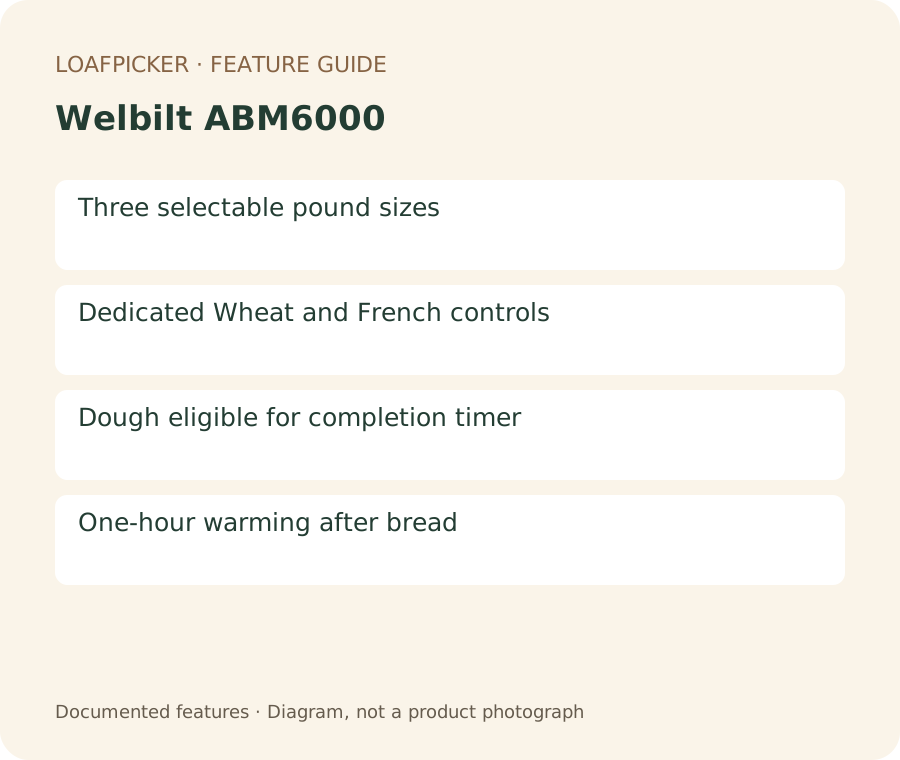
 Original LoafPicker feature diagram. Product references appear below. Not a product photograph.
THE FIT AT A GLANCE
At a glance
Conventional three-size bread flexibility and scheduled owner-finished dough.
Unverified timer maximum, a French instruction error and no automatic additions or custom proof editor.
Shop this model on Amazon ↗Affiliate link · Model search.
The ABM6000 has a straightforward documented appeal: one-, one-and-a-half- and two-pound size selections, separate Basic and Wheat programs, French bread, Rapid and Dough. Its timer can schedule bread or dough, but the inspected instructions do not specify the maximum delay. There is also a genuine error in the French-setting paragraph. These limits do not erase the machine's useful conventional controls; they explain which claims an owner or buyer can rely on. This assessment uses original documentation and does not report a hands-on bake or current retail offer.
The three size positions are visible in the original scan
The scanned guide's control panel was inspected visually because the PDF has no extractable text. It identifies ABM6000 and shows separate one-, one-and-a-half- and two-pound indicators beside Size of Loaf. That is stronger size evidence than an unverified retailer description. Basic and Wheat instructions also explicitly direct the owner to choose among those quantities. Match that panel and the underside model label with the offered machine before using the guide.
Those controls make it relevant to a household that alternates a modest loaf with a larger batch. The larger pan still needs the appropriate formula and room for expansion; the initial ingredient volume is not the capacity limit by itself. Finished slice size and shape are not measured here, and exterior width/depth/height were not established reliably. Check the actual counter, open lid and pan-removal clearance when planning where to use it.
French exists, but one instruction names the wrong setting
The panel visibly has a French choice. The cycle table and troubleshooting text also recognise French as a separate process. Yet the paragraph headed as French instructions says to select Basic. That contradiction was checked in the original scan rather than inferred from an unreliable transcription. It should remain visible in an owner reference, instead of silently rewriting the booklet as though every passage agreed.
For a buyer, this means the dedicated course is well established while that particular operating sentence needs clarification. Use the exact panel and model-specific source when requesting help, and do not borrow another Welbilt's menu numbers to repair the discrepancy. A familiar recipe and known setting are a better starting point than a complex formula whose method depends on the disputed line.
Rapid is a shorter conventional cycle
The cycle information puts Rapid at roughly two hours fifty minutes to three hours, depending on browning. It is not a one-hour emergency loaf. Its purpose is to shorten the normal bread routine within the machine's own sequence. Follow the corresponding formula rather than assuming any Basic or Wheat recipe will behave identically when given less time. Cooling and slicing extend the practical meal schedule beyond the displayed cycle.
Light, Medium and Dark choices are documented for the baked-bread processes. A dedicated Wheat program is present, but no dedicated Gluten-Free program or authenticated exact GF recipe was established. A broad menu of conventional wheat breads should not be presented as specialty-diet validation. Buyers who need an exact supported GF method must obtain separate model-specific evidence before treating this as a match.
The timer supports Dough, with an unknown maximum
The programmable-timer directions explicitly refer to when bread or dough should be ready. They give a ten-hour example and explain counting the interval to completion. That example establishes the illustrated appointment, not a ten-hour maximum or a commonly assumed twelve- or thirteen-hour ceiling. Neither the maximum nor adjustment increments were established clearly enough to promise here. Check the actual unit and complete instructions if the timing limit determines the purchase.
Dough kneads and rises the mixture before the owner removes it for shaping and conventional oven baking. Timer use requires an ingredient-appropriate recipe; the instructions exclude perishables. Plan to be present for the handoff rather than leaving finished dough to continue rising while your schedule changes. This is scheduled preparation, not an automatic system that can judge readiness and indefinitely pause the result.
There is no established automatic addition system
The recipe directions describe adding ingredients by hand before the final kneading period ends. No automatic fruit-and-nut compartment is documented, and a dependable reminder signal was not established. Someone planning fruit loaves needs a way to follow the exact recipe's addition timing. The presence of a timer does not supply that missing attendance or physical ingredient release.
The five fixed programs also do not establish independently timed proofing, a saved custom cycle or adjustable fermentation temperature. Dough is useful, but it should not become a claim of a supported long natural-starter method. An owner experimenting with fermentation would be creating and monitoring a separate process. That is different from buying a machine because the manufacturer has documented the method and its limits.
Condition and source completeness affect its value
The original specification gives 120 V, 60 Hz with a 650 W heater and 120 W motor. Bread programs have an hour of warming; Dough has no baked loaf to hold. Power interruption cancels the process rather than resuming at the same stage. The nonstick pan and blade need the specified hand care, and the inspected instructions do not identify a ceramic coating.
Inspect the pan attachment, blade, coating, controls and cord before choosing a used example, and verify any replacement part against ABM6000. The original model scan and fuller manual transcription provide a useful starting point, but no present warranty or parts inventory was tested. A complete machine can be relevant for conventional size flexibility and scheduled dough. Its timer uncertainty, French paragraph error and lack of specialty fermentation evidence should remain part of the decision.
Documented specifications
- Model
- ABM6000
- General loaf sizes
- 1 lb, 1.5 lb, 2 lb
- Dedicated GF course
- No
- GF capacity basis
- No dedicated GF menu or authenticated exact-model GF recipe established.
- Automatic add-ins
- No
- Complete adjustable cycle
- No
- Body dimensions
- Not confirmed in the primary sources used here