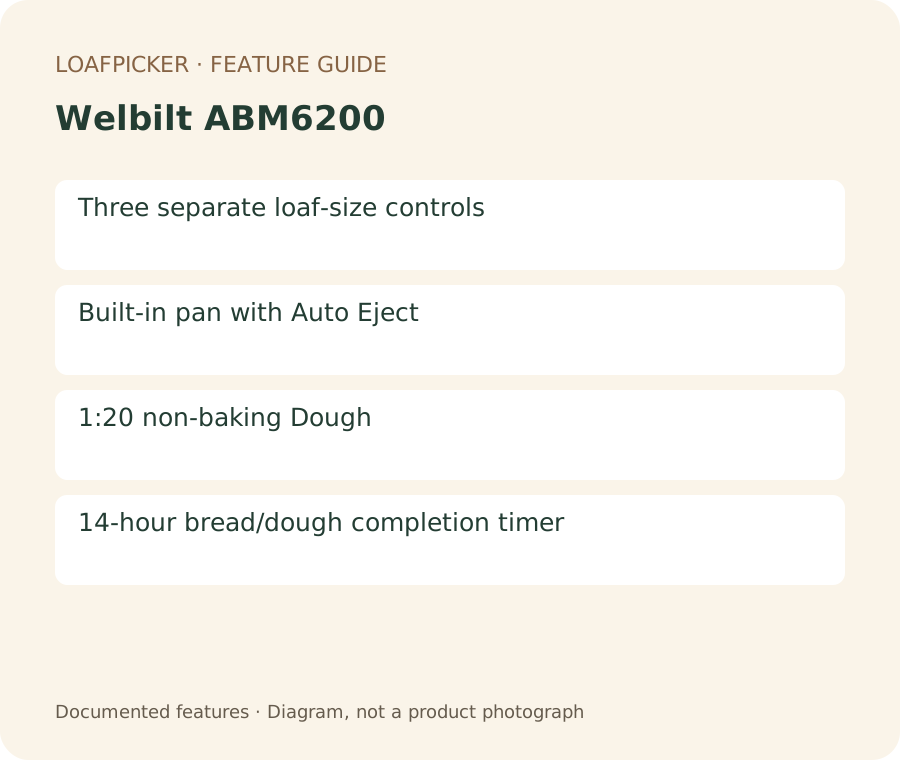
 Original LoafPicker feature diagram. Product references appear below. Not a product photograph.
THE FIT AT A GLANCE
At a glance
Conventional bread and oven-finished dough for an owner who specifically wants the intact Auto Eject assembly.
Built-in pan, blade retained in loaf and special removal tools make completeness and mechanical condition crucial.
Shop this model on Amazon ↗Affiliate link · Model search.
The Welbilt ABM6200 deserves attention for a very specific reason: it lifts the finished loaf out of a built-in bread pan. That mechanism changes how you remove bread, clean the machine and assess a used example. Its ordinary bread settings are straightforward, but buying it as though it were a conventional machine with a removable bucket overlooks the parts that make this model work. An intact example is most interesting to someone who wants its unusual removal system and is prepared to maintain an older appliance.
The original booklet’s cover explicitly identifies Model ABM6200 and shows the Baker’s Select name and Auto Eject system. This establishes the model much more securely than a generic Welbilt listing. The assessment here follows that booklet; it does not claim a practical baking test, measured noise level or current parts availability.
What the eject system actually does
Five minutes after baking ends, the manual says the machine beeps, opens its lid and slowly ejects the loaf. You can request ejection earlier with the Eject button. You still remove the hot bread yourself, using the supplied loaf lifting tool and oven protection. The system therefore changes the release step rather than delivering a cooled loaf ready to slice. You also need clear space above the lid when the machine operates.
The kneading blade is another important detail. It screws onto a threaded shaft and remains in the bottom of the loaf after ejection. A separate twist-off tool engages the blade so that you can pull it out of the hot bread. Before buying a used ABM6200, check for both tools, inspect the blade and threaded connection, and ask for a demonstration of the lid and ejection action. A functioning display alone says little about those mechanisms. Improvising with metal utensils risks damaging the coating or struggling with hot bread.
Conventional bread choices, three actual size positions
The panel offers 1, 1½ and 2 lb selections, three crust shades, four bread cycles and Dough. Basic and French handle familiar yeast breads; Whole Wheat begins with a 30-minute warming period; Rapid shortens the schedule. Those are genuine preset differences, but they do not let you independently rewrite fermentation stages. The indicator lights show progress rather than provide an editable baking sequence.
The printed chart makes the schedule tradeoffs tangible. Basic and French run from 3:20 to 3:30 depending on crust shade. Rapid runs from 2:35 to 2:45. Whole Wheat takes 4:31 to 4:41, including its initial warming stage. These are the booklet’s cycle figures, not measured results. Rapid is a modest time saving within that group; someone expecting a roughly one-hour emergency loaf should look elsewhere. A longer Whole Wheat countdown also need not mean the machine has failed to start.
Choose the amount you actually eat before choosing the size setting. The largest loaf is useful for a household that consumes it promptly, while smaller recipes can reduce leftover bread. Keep recipe quantity and the selected size aligned. The shared built-in pan does not become smaller when you select 1 lb, so loaf proportions will still differ with the amount of dough.
Dough and delayed completion
Dough takes 1:20 and mixes, kneads and raises the ingredients without baking. It is a sensible route for pizza or hand-shaped rolls when you want to use a conventional oven. Auto Eject is disabled in this program; you open the machine and remove the dough manually. The fixed sequence does not establish a dedicated natural-starter process or independent proofing control. A baker who needs several freely timed rises should not mistake Dough for a custom fermentation mode.
The timer explicitly supports completion of bread or dough up to 14 hours later. That can help fit dinner rolls into a working day, provided the chosen recipe is suitable for waiting. The manual excludes recipes containing perishables such as eggs, fresh milk and cheese from delayed use. Count backward from the time you need to handle the dough, because the next stages—shaping, further proofing when required and oven baking—still need your attention.
Additions and gluten-free expectations
This machine has no documented automatic fruit-and-nut dispenser. The instructions put additions directly into the pan at loading, including fruit or nuts with the liquids. Auto Eject refers to the finished bread and has nothing to do with dispensing ingredients. If you value intact pieces added late in mixing, the documented workflow is a meaningful limitation rather than a convenience feature.
There is no dedicated gluten-free course in the five-choice menu. The reviewed booklet also does not establish an exact gluten-free recipe and capacity for this model. That does not prove that experimentation is impossible, but it leaves a new gluten-free buyer without a documented starting workflow. A machine whose maker specifies the intended flour blend, course and quantity is easier to evaluate for that purpose.
Cleaning and the purchase decision
The built-in pan requires cleaning in place after the machine is unplugged and cool. The booklet describes a soft, soapy sponge or water inside the pan; the appliance itself must never be immersed. Look closely at the fixed pan’s surface and the shaft area before committing to a used unit. A badly worn built-in baking surface creates a different ownership problem from replacing an ordinary removable pan.
The documented supply is 120 V, 60 Hz AC. Check the actual appliance label and condition, including the cord, before use. Current service support, replacement-tool stock and reliable external dimensions were not established. The ABM6200’s strongest case is its complete, functioning auto-eject assembly combined with familiar bread recipes. Missing tools, a questionable release mechanism or a need for documented gluten-free and adjustable fermentation programs weaken that case substantially.
Documented specifications
- Model
- ABM6200
- General loaf sizes
- 1 lb, 1.5 lb, 2 lb
- Dedicated GF course
- No
- GF capacity basis
- No dedicated GF course or exact GF recipe established in the model booklet.
- Automatic add-ins
- No
- Complete adjustable cycle
- No
- Body dimensions
- Not confirmed in the primary sources used here