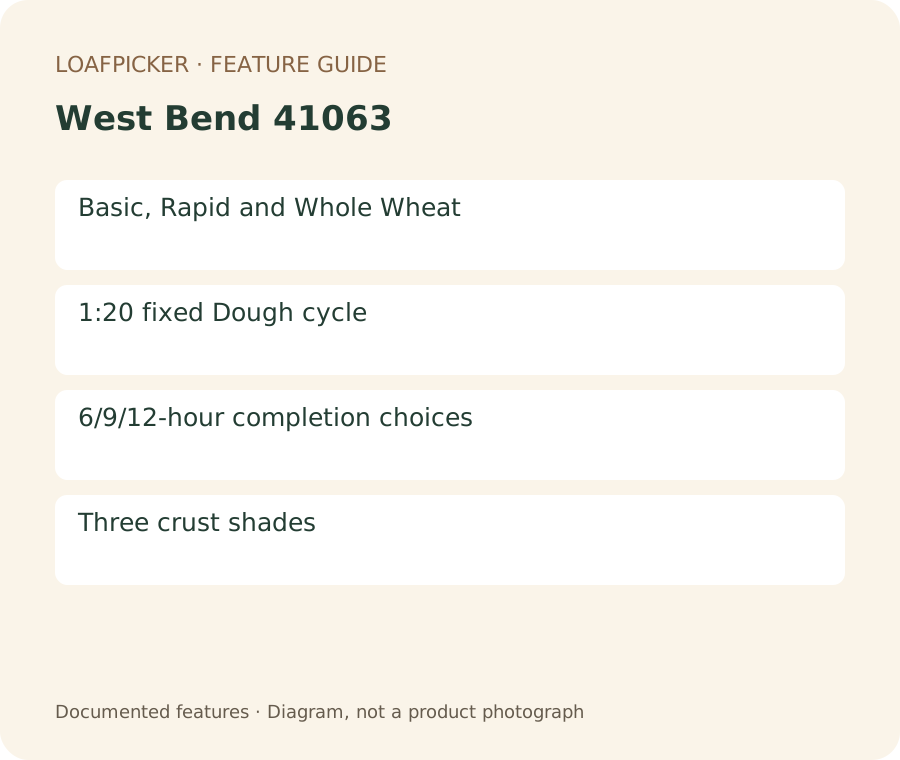
 Original LoafPicker feature diagram. Product references appear below. Not a product photograph.
THE FIT AT A GLANCE
At a glance
Simple conventional bread or delayed oven dough when fixed completion intervals fit the household schedule.
No independent weight selector; the timer only offers 6, 9 or 12 hours, and additions require attendance.
Shop this model on Amazon ↗Affiliate link · Model search.
The West Bend 41063 makes most sense as a straightforward older breadmaker for conventional loaves and oven-finished dough. Its limited controls are easy to understand once you know their boundaries: three bread settings, three crust shades, Dough and three delayed completion choices. There is no digital menu of dozens of foods, no independent fermentation editor and no dedicated gluten-free course. The useful question is whether those simple choices fit your recipes and your daily schedule.
West Bend’s own manual index links model 41063 to booklet L5225 and describes the appliance as a 1.5 lb breadmaker. That matters because the same booklet serves several catalog numbers. Use the number on the back or bottom of the machine to identify yours. The booklet number itself is a document identifier, not a substitute model number. This review interprets the maker’s instructions and does not represent a hands-on test of a surviving unit.
Recipe size and the actual controls
The book includes 1 lb and 1½ lb recipe quantities, but the control description has no separate loaf-weight button. You choose a suitable recipe amount and then the bread program and crust shade. The maker recommends Light or Medium for the smaller 1 lb loaf to avoid excessive browning. This is a useful distinction when a used listing advertises two sizes: recipe capacity does not imply two independently selectable weight programs.
The stated maximum is consistent with recipes and mixes for a 1½ lb loaf. The adaptation guidance limits bread recipes to three cups of flour. That is a more useful operating boundary than guessing whether extra dough will physically fit into the pan. Increasing a recipe can crowd the lid or overload the intended process even if the ingredients initially sit well below the rim. For a larger household, make sure a 1½ lb maximum matches your consumption before comparing cosmetic condition.
Basic, Rapid and Whole Wheat have distinct schedules
Basic takes 3:40, Rapid 3:10 and Whole Wheat 3:50 according to the control instructions. Rapid therefore saves half an hour relative to Basic; it is not the very short cycle found on some later machines. The maker favors fast-rising or bread-machine yeast for Rapid. Starting from the exact book’s recipes gives you a clearer basis for judging the machine than importing a formula designed around a much faster cycle.
Basic and Rapid are intended for recipes with at least half bread flour. Whole Wheat supplies the longer kneading treatment needed when that proportion is lower. Choose it according to the flour mixture rather than the color of the finished loaf. Rye, oats or whole grains can change dough behavior, and the course name alone cannot compensate for an oversized or poorly balanced recipe. The instruction book contains the starting formulas needed to learn those differences without treating every dense loaf as a mechanical fault.
The timer works in three large steps
The most distinctive convenience limitation is delayed completion at six, nine or twelve hours from starting the timer. You do not enter an arbitrary finishing time in ten-minute increments. If you set nine hours at bedtime, the machine aims to finish nine hours later. That may suit a stable routine, but it is less adaptable when your morning schedule changes or you want dough ready at a particular point in dinner preparation.
The timer supports all three bread programs and explicitly supports Dough. Recipes must be suitable for waiting: the manual prohibits delayed use with perishables such as milk, eggs, cheese or yogurt. Its marked recipes provide a starting guide. A large delay allowance is not permission to leave any formula unrefrigerated. Choose the recipe first, then choose a permitted completion interval.
After bread baking, Keep Warm can run for up to three hours. Treat this as a holding period rather than extra timing precision or continued fermentation control. Remove bread promptly when its crust matters to you, using oven protection for the hot pan. Dough receives no keep-warm holding period; the maker tells you to remove it when the process ends because it continues rising.
A useful fixed Dough cycle
Dough takes 1:20. It mixes, kneads, allows a rise and finishes with a brief punch-down before switching off. This is a practical fit for rolls, cinnamon rolls, bread sticks and other shapes you finish in an oven. Include the remaining shaping and baking time in your plan; the timer only gets you to the end of the machine’s part of the recipe.
That fixed dough preparation is not a complete custom cycle. The panel does not establish individually adjustable kneading, proofing or baking periods, nor does the book establish a natural-starter workflow. If your main purpose is managing a slow starter through changing fermentation times, the machine’s simple controls provide little documented assistance. For ordinary commercial-yeast dough, their simplicity may be entirely adequate.
Additions, maintenance and a used-unit check
An audible signal midway through kneading tells you when to add ingredients such as raisins or nuts. It applies to bread and Dough, but you must be there to open the lid and add them. There is no automatic ingredient dispenser. Scheduled plain bread can therefore be straightforward; a loaf needing late additions adds a separate attendance requirement.
The removable pan and knead bar are central to assessing an older example. Confirm that the pan locks properly, the bar matches the shaft and the coating and shaft seal remain sound. The book directs you to clean the pan’s interior without immersing its base or putting it in a dishwasher. Its instructions also state that a power failure turns the machine off and that it remains off when power returns, so do not assume modern outage recovery.
The documented electrical service is 120 V, 60 Hz, with a warning against converter or transformer use. Current replacement-part availability and external dimensions were not established. A complete 41063 is best judged as a modest-capacity conventional bread-and-dough helper with unusual fixed timer intervals. Buyers needing exact finish-time entry, automatic additions, dedicated gluten-free programming or adjustable fermentation have clearer reasons to choose another design.
Documented specifications
- Model
- 41063
- General loaf sizes
- 1 lb, 1.5 lb
- Dedicated GF course
- No
- GF capacity basis
- No dedicated GF course or exact GF recipe established in L5225.
- Automatic add-ins
- No
- Complete adjustable cycle
- No
- Body dimensions
- Not confirmed in the primary sources used here