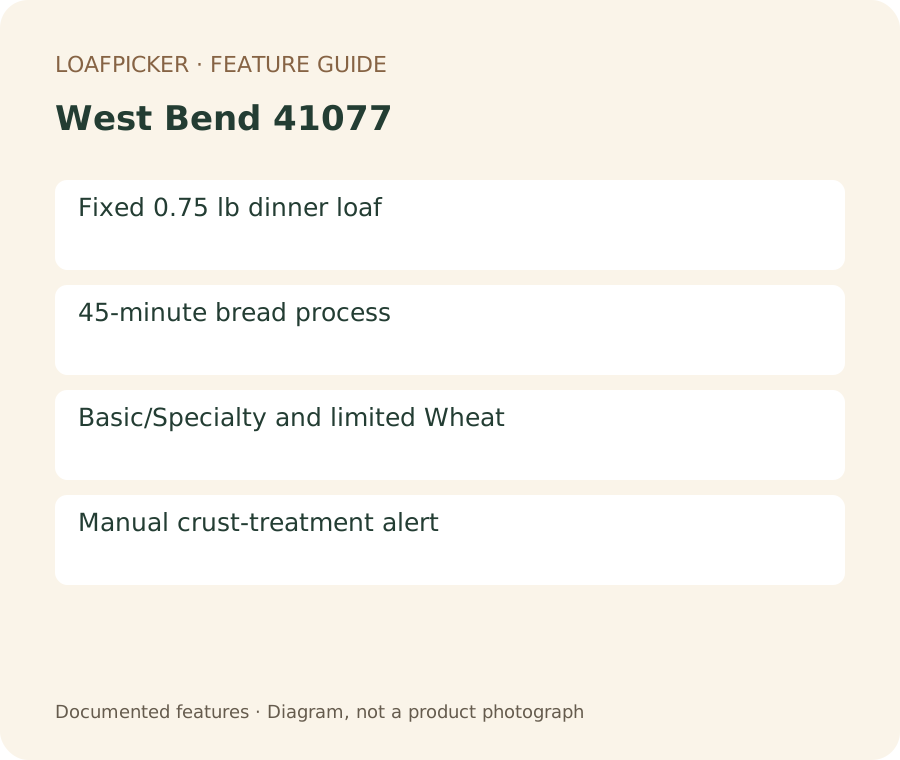
 Original LoafPicker feature diagram. Product references appear below. Not a product photograph.
THE FIT AT A GLANCE
At a glance
Small dinner accompaniment using exact fast-rising-yeast recipes and a short attended preparation routine.
Fixed capacity and no Dough or delay; Wheat permits only up to 50% whole-wheat flour.
Shop this model on Amazon ↗Affiliate link · Model search.
The West Bend 41077 has an unusually narrow purpose: making a small loaf to serve with a meal. West Bend identifies it as a ¾ lb breadmaker, and the Just for Dinner instructions describe a complete 45-minute knead, rise and bake process. That combination can appeal to a small household that wants fresh dinner bread without keeping a larger loaf. Its appeal depends on accepting a very specific recipe system and a short list of controls.
This model should not be evaluated as a miniature version of every full-size breadmaker. The official manual provides two bread selections, Basic/Specialty and Wheat. It does not document a Dough program, a delayed-start timer, a loaf-size selector or a dedicated gluten-free course. The review below is based on the exact manual linked by West Bend for 41077, rather than on tested results from an individual used machine.
Small capacity is the point
The manual’s ingredient limits are particularly important here. A dinner loaf should not use more than 1⅓ cups of bread flour; combinations containing other flours, cereal or oats should not exceed 1½ cups total. These amounts are much smaller than a typical 1½ or 2 lb machine recipe. A larger machine’s favorite formula cannot simply be poured into this pan because its flour volume looks manageable before mixing.
The book also gives special directions for packaged mixes. A normal package can be too large for the machine, and its instructions divide the mix rather than use it all. They also adjust yeast for the short schedule. For a buyer who relies on convenient complete mixes, this means extra measuring and keeping track of what remains in the package. Starting with a dinner-size formula from the exact manual is easier to evaluate than guessing at a reduction.
The small loaf could reduce leftovers when bread is an accompaniment rather than the main source of sandwiches for several people. Work backward from your own portions: a fixed ¾ lb format offers no larger setting when guests arrive. Nor does the short bake eliminate the cooling time needed before clean slicing. The book recommends 15–20 minutes on a rack after removal, so allow more than 45 minutes between pressing Start and serving tidy slices.
The Wheat label has a substantial restriction
Basic/Specialty is intended for recipes mainly using bread flour. Wheat is for mixtures containing up to 50% whole-wheat flour. The manual specifically advises against recipes made entirely with whole-wheat flour. That makes the Wheat setting useful for mixed-grain dinner bread, but it does not establish a documented 100% whole-wheat process. A buyer choosing the machine mainly for an all-whole-grain loaf should take that limitation seriously.
The exact recipes use fast-rising or bread-machine yeast. The maker tells owners not to use active dry yeast in this short process. That detail explains why adapting a familiar slow recipe involves more than changing its batch size. Yeast type, amount and the shortened fermentation schedule work together. A listing that promises quick bread without mentioning those requirements leaves out a meaningful part of everyday use.
Simple operation with a useful manual finishing moment
You select Basic/Specialty or Wheat and press Start/Stop. The operating light changes when baking has finished, and the machine can hold the bread warm for one hour before switching itself off. There are no documented Light, Medium and Dark crust positions. If you want an appliance that automatically stores different preferences for several people, the controls here offer very little to configure.
A signal about 22 minutes after starting, shortly before baking begins, invites you to add a crust treatment. That is an opportunity for a brushed or decorated top, rather than an automatic ingredient-release feature. The booklet illustrates treatments and warns against cooking spray near the heating element. You need to be present at that moment, which suits a dinner preparation routine more naturally than unattended overnight baking.
Consecutive loaves also need planning. The manual tells you to cool the machine for 15–20 minutes with its cover open before restarting so its temperature sensing works properly. Two loaves therefore involve the first full process, unloading, a cooling interval and the next process. Buying two small batches’ worth of ingredients does not make this equivalent to a larger-capacity machine.
Where its documented abilities stop
No dedicated dough-only cycle is provided. The controls also do not establish independent kneading or proofing stages, a stored custom sequence or a natural-starter program. Interrupting a bread process may be something an experienced owner experiments with, but that is different from having a documented automatic dough routine. If pizza, rolls shaped by hand or adjustable fermentation are your main goals, this model lacks the corresponding controls.
The manual does not provide a dedicated gluten-free course or an exact gluten-free recipe and capacity. Its Wheat program is plainly a wheat-containing workflow. Do not interpret small size, rapid baking or a general specialty-bread label as evidence of gluten-free suitability. A buyer needing that function should have a documented formula and appropriate process to assess.
Inspect the pan and identify the exact machine
Check the catalog number on the appliance against West Bend’s manual index. Confirm that the small removable pan locks securely, the knead bar is present and the pan’s shaft area and coating are sound. The maker prohibits immersing the pan or putting it in a dishwasher because the bearing can be damaged. The instructions also say the machine remains off after a power interruption; there is no documented automatic recovery period to rely on.
The book specifies a 120 V AC outlet and warns against converters or transformers. Exact wattage, frequency, external dimensions and current parts stock were not established in the reviewed material. The 41077’s strongest fit is a complete, working dinner-bread appliance used with its own small, fast-yeast recipes. Its limited capacity and controls are central to that choice.
Documented specifications
- Model
- 41077
- General loaf sizes
- 0.75 lb
- Dedicated GF course
- No
- GF capacity basis
- Two-course menu has no dedicated GF program; no exact GF formula established.
- Automatic add-ins
- No
- Complete adjustable cycle
- No
- Body dimensions
- Not confirmed in the primary sources used here