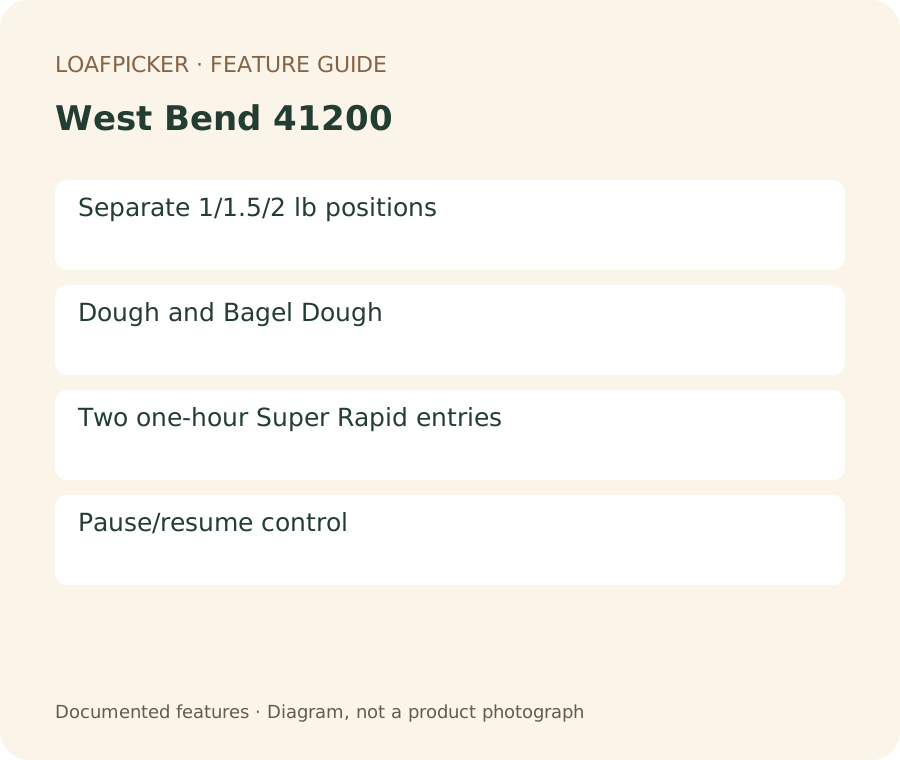
 Original LoafPicker feature diagram. Product references appear below. Not a product photograph.
THE FIT AT A GLANCE
At a glance
Conventional loaves in three selected sizes plus scheduled oven-finished dough or bagel dough.
No dedicated GF or editable proofing; manual additions and course-specific delay exclusions.
Shop this model on Amazon ↗Affiliate link · Model search.
The West Bend 41200 is an earlier 2 lb breadmaker whose strongest documented advantages are ordinary loaf-size flexibility and two distinct dough choices. The official instructions give it separate 1, 1½ and 2 lb settings, a Wholewheat program, two one-hour Super Rapid entries and both Dough and Bagel Dough. That is a useful set of options for someone who alternates between machine-baked bread and shapes finished in the oven. It does not include a dedicated gluten-free course or a complete custom-cycle editor.
West Bend links the plain 41200 to L5689A in its manual index and lists 41200CF separately. Match the catalog number on your appliance to that index before using instructions found with a similar-looking machine. The assessment here concerns the plain 41200 and follows its manufacturer manual; it does not claim measured baking performance, sound levels or long-term reliability.
Three sizes without assuming every course behaves identically
The Loaf button selects 1, 1½ or 2 lb, and the default is the largest size. This is helpful for a household whose bread consumption changes across the week: a smaller ordinary loaf may be enough for two people, while a larger recipe can serve more sandwiches. Select a recipe written for the intended amount as well as the corresponding panel setting. A weight button changes the program’s treatment; it cannot correct an overfilled recipe.
Color provides Light, Medium, Dark and a Rapid option. The manual also has separate Super Rapid programs for 1½ and 2 lb loaves. Those are different controls, so a reference to “rapid” in a listing can be imprecise. For an owner, the safest way to establish a repeatable result is to record the actual menu, loaf size and color choice used with a particular recipe rather than recording only that it was a quick loaf.
Read the menu as several different kinds of preparation
Basic, French, Wholewheat and Sweet cover familiar yeast breads. Wholewheat is intended for recipes containing at least half whole-wheat flour or comparable heavier mixtures. Menu 8 is described as Brown Bread for darker recipes such as rye or pumpernickel, although the timer section calls the same numbered selection Dark. That wording variation is worth recognizing when navigating the booklet.
Super Rapid 1½ lb and Super Rapid 2 lb are described as producing loaves in an hour. Their shortened timing is a specific recipe choice rather than a universal speed switch. The book’s directions call for an increased yeast amount when adapting a yeast recipe for these programs. Do not assume that a favorite formula designed for several hours will behave the same when placed on a one-hour schedule.
Quick is a different category again: it is for chemically raised breads that need mixing and baking without yeast fermentation. Jam cooks fruit mixtures, while Bake supplies baking or extra browning without running a full bread program. Their presence makes the machine more versatile, but none of these names establishes a dedicated gluten-free process. The exact menu contains no gluten-free entry, and an exact-model gluten-free formula and quantity were not established in the reviewed book.
Dough and Bagel Dough are meaningful options
Menu 9 prepares dough without baking. Menu 10 separately prepares bagel dough. That distinction is useful if you want the machine to do the mixing and initial development while retaining control over the final shape and oven treatment. The included dinner-roll and bagel recipes provide a more appropriate starting point than assuming every dough behaves like a basic sandwich loaf.
Budget time beyond the machine’s completion signal. Rolls still need shaping and any further rise required by the recipe; bagels also need their specified finishing process. The machine ending its work is therefore a handoff point. It is not the same as dinner being ready. For someone willing to do that finishing work, the two dough menus may be more valuable than a large collection of additional bread names.
The Start/Stop control can pause and resume a running program, according to this manual. That can be useful when you need to attend to the contents, but it does not let you set individual fermentation temperatures or rewrite all rise durations. No full custom cycle or independently adjustable proofing stage is established. Treat natural-starter use as unsupported experimentation rather than a documented automatic function.
Delay has an explicit course list
The delayed completion limit is 12 hours and 58 minutes. The display represents time until the program finishes. The maker explicitly allows delay on Basic, French, Wholewheat, Sweet, menu 8, Dough and Bagel Dough. Super Rapid, Quick, Jam and Bake are excluded. Those distinctions matter more than rounding the specification up to a generic thirteen-hour timer.
The manual also prohibits delayed use with perishables such as milk, eggs, fruit and yogurt. A permitted menu does not make every recipe suitable for waiting. Check the ingredient list before relying on a morning bread schedule or an afternoon dough finish. Add-ins create another attendance issue: the machine sounds a signal during the second knead of selected bread programs, but it has no automatic fruit-and-nut dispenser.
What to check before choosing an older example
Inspect the exact pan, knead bar, attachment and coating. Confirm that the pan locks correctly and that the shaft area is clean and does not leak. The maker warns against immersing the pan or washing it in a dishwasher. Its outage memory is documented only for interruptions shorter than five minutes, so a timer should not be treated as protection against a prolonged power failure.
The book specifies a 120 V AC outlet. Reliable external dimensions, full electrical nameplate details and current replacement-part stock were not established. The 41200 is most persuasive for conventional recipes in several sizes and scheduled oven dough. A need for automatic additions, dedicated gluten-free programming or adjustable fermentation gives you a clear reason to compare other machines.
Documented specifications
- Model
- 41200
- General loaf sizes
- 1 lb, 1.5 lb, 2 lb
- Dedicated GF course
- No
- GF capacity basis
- No GF-specific course or exact GF recipe established in L5689A.
- Automatic add-ins
- No
- Complete adjustable cycle
- No
- Body dimensions
- Not confirmed in the primary sources used here