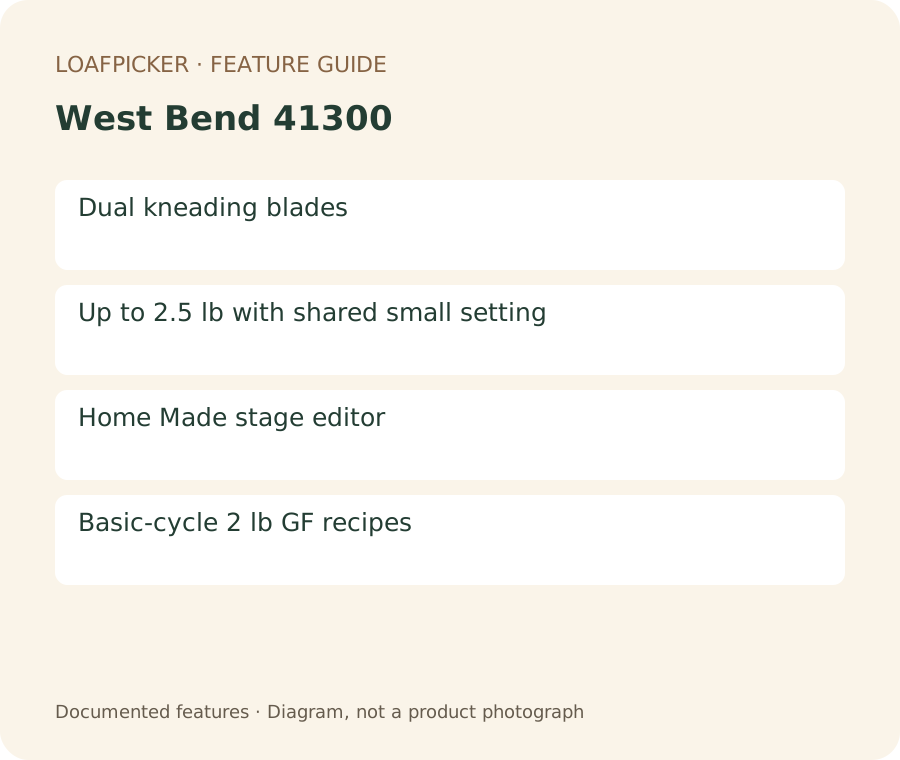
 Original LoafPicker feature diagram. Product references appear below. Not a product photograph.
THE FIT AT A GLANCE
At a glance
Larger conventional loaves and experienced supervised baking using adjustable knead, rise, bake and warming periods.
Editor has nonzero minimum kneads/rises and no demonstrated thermal editor; GF recipes run on Basic.
Shop this model on Amazon ↗Affiliate link · Model search.
The West Bend 41300 combines a large dual-kneader pan with something genuinely useful to an experienced baker: an editable Home Made program. Its value is not simply the number of menu entries. You can change kneading, rising, baking and warming times, allowing more control than a fixed Dough cycle offers. The tradeoffs are the editor’s finite ranges, manual ingredient additions and a gluten-free recipe section that uses Basic rather than a dedicated gluten-free course.
West Bend’s official index identifies 41300 as a 2.5 lb breadmaker and links it to L5778WEB. The manual’s cover and parts instructions show the Hi-Rise machine with two kneading blades. This review follows those instructions. It does not report hands-on mixing tests, compare actual loaf height or establish the condition of a used example.
Understand the shared small-loaf position
The panel offers three size positions: 1.0/1.5 lb, 2.0 lb and 2.5 lb. The first is a shared setting, rather than independently selectable 1 and 1½ lb programs. That matters when comparing machines by the number of size choices. There are recipes for smaller quantities, but the control groups them together. The largest setting is the default, so check it before starting a smaller recipe.
The two kneading blades work within the same large pan. Confirm that both are included and fit their shafts correctly when assessing a used machine. Two blades are an additional parts check; the manual alone does not prove quieter operation, stronger kneading or superior mixing. Think first about the loaf quantities you actually consume and the bread shape you want, then consider whether the larger pan and its cleaning requirements suit your kitchen.
What Home Made lets you change
Menu 11 edits a complete sequence. The first knead can run 3–14 minutes, the first rise 20–60, the second knead 8–24, the second rise 1–60 and the third rise 20–120. Baking can be set from zero to 80 minutes and warming from zero to 120. Those documented ranges make this a real stage editor, rather than a collection of preset menu names.
The lower limits also matter. You cannot simply set every unwanted knead or rise to zero. A formula needing no second kneading, or an uninterrupted very long fermentation, may not fit neatly into this sequence. Work through the timing ranges before assuming that a favorite recipe can be automated from start to finish. Keeping a written record of the chosen times and recipe changes will be more useful than repeatedly adjusting several variables at once.
The maker describes saving the customized settings, with loss of memory after a power interruption exceeding five minutes. Home Made initially starts from Basic defaults. It provides a basis for supervised fermentation experiments, but the manual does not establish an automatic natural-starter recipe or unlimited proofing. An active starter can require observation beyond any preset schedule; adjustable stages do not remove that judgment.
Temperature wording needs care
The Temp button selects specified Light, Medium or Dark crust treatments on eligible preset programs. The book associates these with particular temperatures and gives different figures for Quick and Super Rapid. That is useful information about fixed choices, but it does not establish a freely adjustable fermentation or baking temperature within Home Made. Buyers seeking a programmable temperature for each rise should not infer it from the button’s name.
The remaining menus include Basic, Quick, French, Super Rapid, Whole Wheat, Sweet, Dough, Bake, Jam and Sandwich. Quick is for non-yeast quick breads, while Super Rapid is a shortened yeast-bread process. The size-control section includes Super Rapid, although its menu description specifically mentions a 2 lb loaf. Preserve that distinction when choosing an exact recipe instead of treating every amount as equally documented for that fast setting.
Gluten-free recipes are present, but use Basic
The book supplies 2 lb gluten-free recipes built around rice flour, starches and xanthan gum. It directs these to menu 1, Basic. This is useful owner guidance if you already have the machine, but there is no dedicated gluten-free course among its eleven menus. A buyer whose main criterion is a manufacturer-designed gluten-free-specific process should understand that limitation before choosing it.
The same recipe section groups low-carbohydrate bread nearby. Some of those formulas contain wheat ingredients, so the section heading does not make every recipe gluten-free. Read the actual ingredient list and the particular recipe instructions. The gluten-free recipes also contain eggs and call for preparation of the liquid mixture, making an attended first attempt more appropriate than assuming the machine’s timer turns them into overnight recipes.
Plan around the timer and manual additions
The manual specifies a maximum delayed completion time of 12 hours and 58 minutes. Its eligible list covers Basic, French, Whole Wheat, Sweet and Dough. Home Made is not included in that list. The delayed period counts toward the displayed time until completion; it does not extend a custom rise. Recipes with milk, eggs, fruit, yogurt or similar perishables are excluded from delayed use.
Dough prepares a batch for hand shaping and oven finishing without baking it in the machine. That can be useful for planning rolls around a meal, provided you allow for their remaining steps. Add-ins for selected bread programs are prompted by a sound during the second knead. There is no documented automatic ingredient dispenser, so a delayed loaf that needs late additions still requires someone to be present.
Is it a sensible older-machine choice?
Inspect both blades, the pan’s coating, shaft seals and attachment before valuing the editable program. Cleaning instructions protect the pan bearings by prohibiting immersion and dishwasher washing. The manual specifies a 120 V AC supply; full nameplate details, external dimensions and current part availability were not established. The official manual remaining online does not itself prove that a replacement pan can still be ordered.
The 41300 is most compelling for a baker who wants a larger conventional loaf and can make informed use of bounded stage editing. A need for freely set temperatures, automatic additions or a dedicated gluten-free course changes that recommendation. Its actual Home Made controls are worth considering, provided their limits fit the process you want to run.
Documented specifications
- Model
- 41300
- General loaf sizes
- 1 lb, 1.5 lb, 2 lb, 2.5 lb
- Dedicated GF course
- No
- GF capacity basis
- Manufacturer 2 lb GF recipes explicitly use Basic 1, with its 2 lb weight position. No dedicated GF-specific course and no fixed GF course capacity.
- Automatic add-ins
- No
- Complete adjustable cycle
- Yes
- Body dimensions
- Not confirmed in the primary sources used here