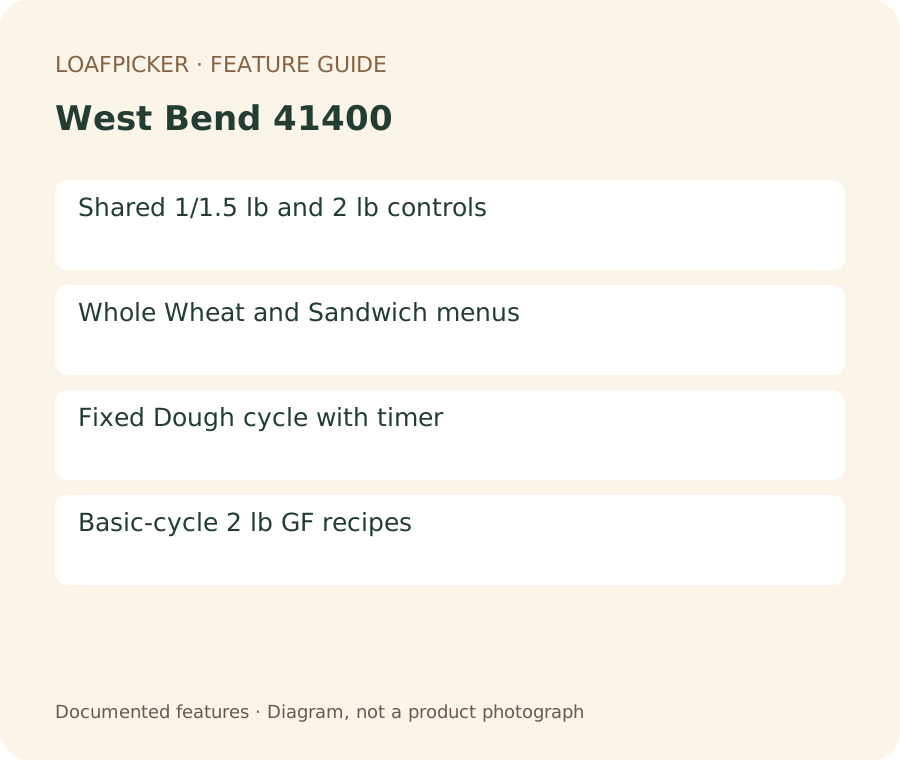
 Original LoafPicker feature diagram. Product references appear below. Not a product photograph.
THE FIT AT A GLANCE
At a glance
Conventional bread, fixed Dough and an existing owner's documented Basic-cycle GF starting formula.
No dedicated GF or proof-stage editor; only two size positions and a restricted delay list.
Shop this model on Amazon ↗Affiliate link · Model search.
The West Bend 41400 offers a useful conventional menu for someone who wants ordinary loaves, dough for the oven and occasional quick breads. Its gluten-free recipe section needs more explanation than a simple feature badge: the maker supplies 2 lb gluten-free formulas, but instructs owners to bake them on Basic. There is no dedicated gluten-free program in its twelve-entry menu. That distinction is central to deciding whether this older model fits your main purpose.
The official West Bend index links 41400 to L5811WEB and lists the 41400CF separately. Match the appliance’s own catalog number before following a similarly named book. The observations here come from the plain 41400 instructions, not a practical bake test or an assumption that neighboring West Bend models share every feature.
Two control positions cover three recipe descriptions
The size button selects either a shared 1/1.5 lb position or a 2 lb position. The manual includes recipes at smaller quantities, but the shared position does not provide separate 1 and 1½ lb timing choices. This is easy to miss when a listing summarizes the machine as supporting three loaf sizes. It supports those recipe amounts differently from a panel with three distinct weight settings.
The Loaf Size control applies to Basic, French, Whole Wheat, Sweet and Sandwich. Other entries have their own intended treatment. Super Rapid 1LB is described as preparing 1 or 1½ lb loaves in less than two hours, while Super Rapid 2LB serves the larger quantity. Use the recipe and its actual program guidance together instead of treating the weight control as universal across all twelve entries.
For a small household, start by deciding whether the smaller recipes in a full-size pan make sense for your eating habits. For several people, the 2 lb capacity may be useful, but it still has a recipe limit. A machine’s larger selection is not an invitation to add more flour until the pan looks full. A repeatable standard recipe gives you a much clearer way to assess the appliance than an improvised oversized loaf.
Choose the menu by the preparation involved
Basic handles familiar bread-flour recipes. Whole Wheat is intended for mixtures with at least half whole-wheat flour, and the recipe section includes a 100% whole-wheat formula. French has its own restriction: the maker says that program is unsuitable for recipes requiring butter, margarine or milk. A rich, soft loaf and a lean French-style loaf should therefore not be assigned to a course merely because you prefer its name.
Quick is for breads without yeast that require mixing and baking. Cake is described for boxed mixes, Sandwich aims for a lighter texture and thinner crust, Jam cooks fruit mixtures, and Bake supplies baking without kneading or resting. These choices are useful for different jobs. They do not form an editable sequence of independent stages, and the book establishes no full custom program or separately controlled proofing temperature.
What the gluten-free recipes do establish
The book’s gluten-free bread and lemon-poppyseed gluten-free bread are labeled 2 lb. They use a combination of rice flour, potato starch, tapioca flour and xanthan gum, with eggs and other liquids. Instructions call for whisking the wet ingredients separately before loading, then using Basic. These are documented owner recipes, rather than evidence of a hidden gluten-free menu or a selectable smaller gluten-free batch.
That gives an existing owner a concrete starting point, but it should not be expanded into unsupported claims. The book does not establish a dedicated gluten-free process, a tested result for every flour blend or proportional smaller versions of those recipes. If gluten-free baking is the main reason for purchasing a machine, compare the clarity of the intended formula and process as well as the headline capacity.
The low-carbohydrate recipes printed nearby are a separate matter. Some include whole-wheat ingredients or vital wheat gluten. A combined section heading is not enough to establish that a formula is gluten-free. Check the individual ingredient list, and do not add the book’s wheat-bread troubleshooting ingredient, vital gluten, to a gluten-free loaf merely because it appears elsewhere in the same manual.
Dough and delay: useful, with a specific eligible list
Menu 8 prepares dough without baking. It is suitable in principle for the book’s oven-finished shapes, with your own time reserved for shaping, any further proof and baking. A fixed Dough program does not supply independent fermentation control for a slow natural starter. No exact natural-starter process is established here, even though the machine can prepare ordinary commercial-yeast dough.
The timer supports completion up to thirteen hours later on Basic, French, Whole Wheat, Sweet and Dough. Sandwich is not in the manual’s eligible list, despite being a bread program. Quick, both Super Rapid entries, Jam and Bake are explicitly excluded. For other unlisted entries, do not infer permission merely from the general timer specification.
The maker prohibits delay with perishables such as milk, eggs, fruit or yogurt. That includes the egg-based gluten-free recipes even though Basic itself is timer eligible. Scheduled completion and unattended recipe suitability are different questions. Additions also need attention: a sound may prompt fruit, nuts or other ingredients during mixing, but there is no automatic dispenser to release them while you are away.
Condition matters more than the menu count
Check that the removable pan and single kneading blade are present, fit properly and have sound working surfaces. Inspect the shaft seal for leakage and ask about operation through an actual cycle. The maker prohibits immersion or dishwasher cleaning of the pan because of its bearing. It documents recovery only for power interruptions shorter than five minutes, not a long outage.
The reviewed instructions specify 120 V AC. Exact full nameplate ratings, outside dimensions and present-day part stock were not established. The 41400 is a reasonable design to assess for conventional bread and oven dough if the individual appliance is complete. Its Basic-cycle gluten-free recipes are useful owner information, while dedicated gluten-free programming and adjustable fermentation remain reasons to compare other models.
Documented specifications
- Model
- 41400
- General loaf sizes
- 1 lb, 1.5 lb, 2 lb
- Dedicated GF course
- No
- GF capacity basis
- Exact 2 lb GF recipes explicitly use Basic 1 and its 2 lb choice; no dedicated GF course or smaller specified GF recipe.
- Automatic add-ins
- No
- Complete adjustable cycle
- No
- Body dimensions
- Not confirmed in the primary sources used here