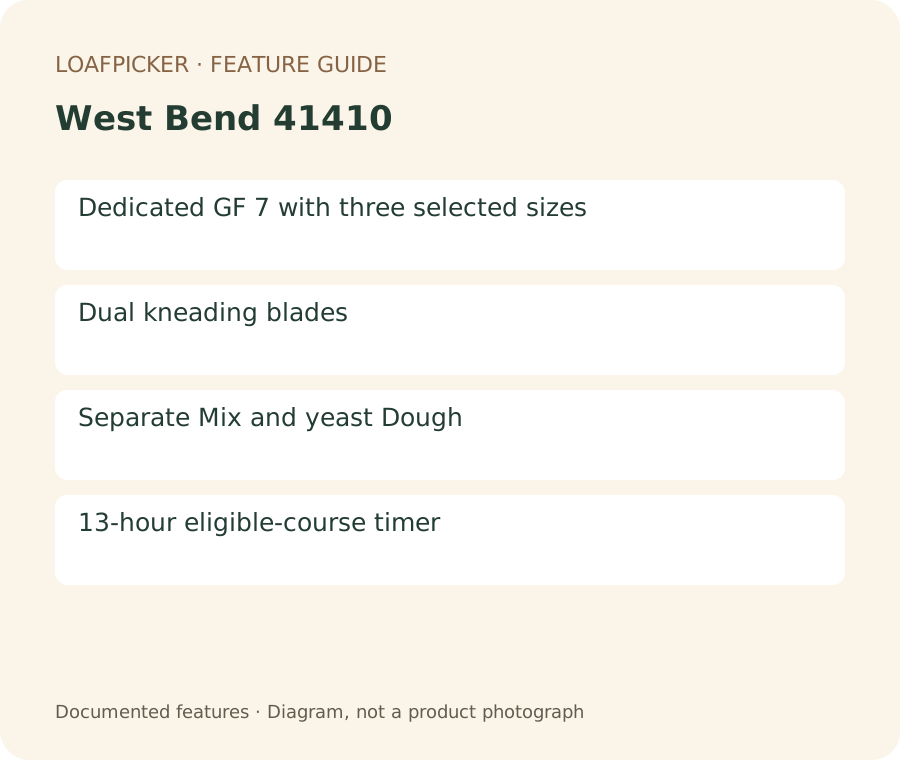
 Original LoafPicker feature diagram. Product references appear below. Not a product photograph.
THE FIT AT A GLANCE
At a glance
Larger conventional or GF loaves with three documented selected capacities and fixed-program oven dough.
No full custom fermentation or dispenser; recipe tables and startup time contain meaningful inconsistencies.
Shop this model on Amazon ↗Affiliate link · Model search.
The West Bend 41410 is worth distinguishing from earlier Hi-Rise models because its manufacturer instructions document a dedicated gluten-free course and three loaf selections that apply to it. The controls provide 1½, 2 and 2½ lb positions. A large-capacity specification alone would not establish those gluten-free options; the explicit course-and-button instructions and cycle chart do. For someone comparing older machines, that is the most useful reason to identify this exact model carefully.
West Bend’s official index lists 41410 as a 2.5 lb breadmaker and links it to manual L5889A. The book shows two kneading blades and a removable pan. This assessment is based on those instructions, including their inconsistencies. It does not claim observed loaf quality, measured motor strength or the current condition of a secondhand appliance.
Capacity: three controls, with imperfect recipe tables
The Loaf button selects 1½, 2 or 2½ lb on Basic, French, Whole Wheat, Sweet, Super Rapid, Sandwich, Gluten Free and Cake. The default is the largest size. There is no documented 1 lb panel position, even though some recipe tables in the book contain 1 lb columns. That mismatch should not become a promise of a fourth independently selected program size.
Use a recipe whose quantities and chosen program are clearly explained before adapting the smaller table entries. The practical benefit of three controls is being able to align a documented amount with an actual setting. The large pan does not automatically make every reduced recipe suitable, and choosing a smaller program cannot correct a formula whose proportions have been changed casually.
Both kneading blades matter to ownership. Check that each one matches its shaft, is free of heavy baked-on residue and can be removed as directed. The pan’s seals and coating deserve equal attention. Two blades are not evidence, by themselves, of better kneading or quieter operation; those outcomes would require actual comparative testing.
The gluten-free course has selectable capacity
Menu 7 is explicitly Gluten Free. The size-control instructions include that menu, and the chart lists 1½, 2 and 2½ lb rows. All three show a total of 1:58, with ten minutes of initial mixing, a 48-minute rise and a 60-minute bake. These are documented program figures, not measured results. Equal total times do not mean the capacity selection is absent: the maker explicitly provides the three positions.
The recipe section supplies 2 lb gluten-free formulas using rice flour, starches and xanthan gum. That 2 lb recipe is one documented starting amount; it does not mean the whole course is fixed at 2 lb. Equally, the existence of three controls does not provide complete tested formulas at every size. A buyer should distinguish program capacity from the exact recipe they intend to use.
The instructions describe premixing the wet ingredients and observing mixing, with assistance around the pan if needed. The included recipes use eggs, so plan an attended first bake and immediate loading-to-start workflow. The nearby low-carbohydrate recipes are not all gluten-free: some use wheat ingredients or vital wheat gluten. Read the individual formula rather than treating the combined recipe-section heading as an ingredient guarantee.
Dough, Mix and the limits of customization
Mix prepares non-yeast dough without baking. Dough is the separate yeast-dough program, and its chart gives 1:50. That distinction can be useful when alternating between simple mixed doughs and rolls or pizza prepared for oven finishing. Once the dough cycle ends, you still handle shaping and any remaining proofing and baking. Schedule that handoff for a time when you are available.
There is no full custom stage editor in the documented twelve-menu system. Dough and a separate Bake function do not establish independent control of fermentation. The wording about losing “customized settings” when cancelling refers to the selected program options; it does not supply an unlisted Home Made menu. Someone choosing a machine mainly for freely timed natural-starter fermentation should not import that feature from the older 41300.
Delay eligibility is broad, but recipe suitability still matters
The manual allows delayed completion up to thirteen hours on the ordinary bread programs, Gluten Free, Dough and Bake. The chart agrees that Mix, Cake and Jam lack delay. This makes scheduled yeast dough possible, but it does not make every ingredient safe or suitable for a long wait. The maker excludes recipes with perishables such as milk, eggs, fruit and yogurt.
That distinction is especially important for gluten-free buyers. The course is timer eligible, but the included egg-based recipes should be started immediately. A specification saying “gluten-free delay” is therefore incomplete without the ingredient restriction. Additions are another limitation: this machine uses a signal for manual additions on eligible settings, rather than an automatic fruit-and-nut dispenser.
Small documentation conflicts worth keeping visible
The startup description gives a 3:20 Basic default, while the chart gives 3:10 for the largest Basic loaf. Some recipes show 1 lb quantities despite the 1½ lb minimum panel choice. French is described as unsuitable for butter, margarine or milk, yet its printed recipe includes butter. These conflicts do not erase the clearly documented controls, but they do mean the book should be read with care. Check the actual panel countdown and obtain clarification before improvising around an unclear formula.
The instructions specify a 120 V AC outlet and memory for power interruptions shorter than five minutes. Exact external dimensions, full nameplate ratings and present-day replacement-part stock were not established. Inspect the pan and both blades, and identify the appliance by its catalog label. The 41410’s strongest documented fit is conventional or gluten-free bread with several selected capacities and fixed-program oven dough. A fully editable fermentation process or automatic additions calls for different controls.
Documented specifications
- Model
- 41410
- General loaf sizes
- 1.5 lb, 2 lb, 2.5 lb
- Dedicated GF course
- Yes
- GF capacity basis
- Gluten Free program 7 permits 1.5 lb, 2 lb and 2.5 lb selections, all listed at 1:58. The printed gluten-free recipe is specifically 2 lb; recipe yield and selectable capacity remain distinct.
- Automatic add-ins
- No
- Complete adjustable cycle
- No
- Body dimensions
- Not confirmed in the primary sources used here