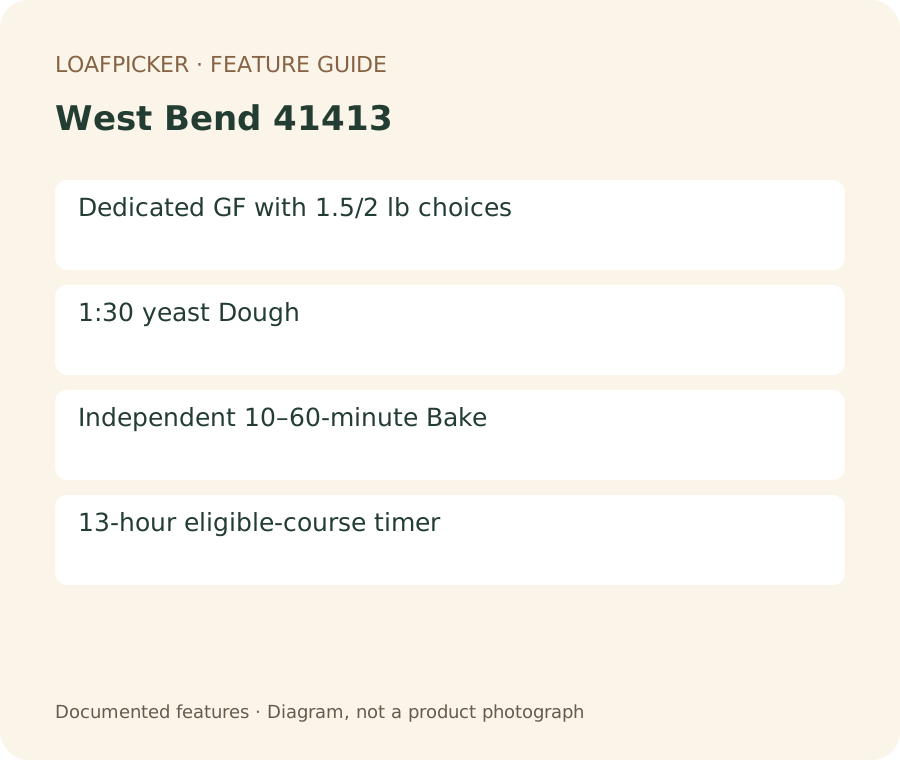
 Original LoafPicker feature diagram. Product references appear below. Not a product photograph.
THE FIT AT A GLANCE
At a glance
Fixed-program conventional and GF bread with two documented selected capacities, for owners who check actual panel labels.
Official numbering and Mix-delay conflicts require care; no complete custom fermentation or dispenser.
Shop this model on Amazon ↗Affiliate link · Model search.
The West Bend 41413 offers a dedicated gluten-free program, two actual loaf-size positions and a separate dough cycle in a single-kneader machine. Those are useful documented functions for a household that wants ordinary bread as well as a gluten-free starting recipe. Its principal research caveat is unusually specific: the maker’s own manual does not consistently number several programs. Owners should match the named course to the appliance’s panel rather than follow an isolated number in the prose.
West Bend’s official index identifies 41413 as a 2 lb breadmaker and links it to L5890A. That link establishes the exact model relationship even though the booklet cover uses the general Automatic Bread Maker title. The assessment here follows that document and its printed timing chart, not a hands-on bake test or an assumption that other West Bend models share the same controls.
Two selected capacities, including gluten-free
The Loaf button provides 1½ and 2 lb choices. Its list of eligible courses includes Basic, French, Whole Wheat, Gluten Free, Sweet, Super Rapid and Sandwich. That means gluten-free capacity is supported by a specific button instruction, rather than inferred from the general 2 lb maximum. The chart independently lists both quantities for the gluten-free program.
Choose an exact recipe quantity as well as its corresponding setting. The book’s gluten-free recipes are labeled 2 lb; a 1½ lb button does not by itself provide a complete smaller formula. If your everyday consumption favors a smaller loaf, the control is relevant, but make sure the intended recipe is suitable before assuming that every ingredient can be reduced by a simple fraction.
The same capacity distinction applies to ordinary bread. A smaller program does not shrink the removable pan or eliminate the need for a balanced recipe. Begin with a clear formula, keep notes on the selected size and use the results to make one considered adjustment at a time. That makes it easier to distinguish a recipe issue from a fault in an older appliance.
How to read the conflicting program numbers
The menu descriptions, gluten-free recipe directions and timing chart all identify Gluten Free as menu 7. The chart places Sweet at 4, Super Rapid at 5 and Sandwich at 6. However, the delay paragraph calls Gluten Free number 4 and shifts several other names, while the size-button list also places Gluten Free differently. These are conflicts within the official document, not reliable evidence of an alternative model or an extra hidden program.
For an owner, the practical response is to inspect the actual panel and select the course by its printed name. If its numbering differs from the chart, seek clarification with the model and date code before applying a recipe. For a buyer, ask for a clear panel photograph and the appliance label. The documentation establishes that the functions exist, but an advertisement repeating one inconsistent menu number is not enough to identify the intended workflow.
The gluten-free process is short and specific
The chart gives both gluten-free sizes a total of 1:58: ten minutes of mixing, a 48-minute rise and a 60-minute bake. This is a dedicated course with selectable quantities, not a fixed 2 lb program simply because the supplied recipe uses that amount. The figures describe the manufacturer’s schedule; they do not establish the texture or height that every flour blend will produce.
The gluten-free recipes combine rice flour, potato starch, tapioca flour and xanthan gum, with eggs and other liquids. The maker calls for separately mixing the wet ingredients and discusses observing the batter during mixing. That gives owners a concrete starting method while also showing why a first attempt should be attended. A thick gluten-free batter need not resemble an elastic wheat-dough ball.
The adjoining low-carbohydrate formulas are a different category. Some contain wheat ingredients or vital wheat gluten, so the combined section heading does not make them gluten-free. Read each ingredient list and follow the directions attached to the particular formula. A bread program’s name is not a substitute for checking what goes into the pan.
Dough, Mix and extra baking
The chart identifies Mix as menu 8 for non-yeast dough and Dough as menu 9 for yeast dough. Dough takes 1:30 and leaves you responsible for shaping, any later rise and oven baking. That can be helpful for pizza or rolls, provided the completion time fits the rest of the recipe. It is a handoff to the baker, not a finished meal.
Bake is separate and can run in ten-minute steps up to one hour without kneading or resting. It can provide additional baking when needed. These functions do not form a full editable fermentation sequence, and the manual establishes no independently adjustable proofing stage or exact natural-starter process. Choose the machine for its fixed programs rather than attributing Home Made controls from a different West Bend model to it.
Delay and additions need their own checks
The thirteen-hour timer represents time until completion. Despite the numbering errors, the prose and chart both support delayed ordinary bread, Gluten Free and Dough. Mix is less clear: the prose permits it while the chart marks delay unavailable. Treat that particular function as unresolved until checked on the actual unit. Do not extend a broad timer claim to every menu.
The maker prohibits delay with perishables such as milk, eggs, fruit and yogurt. The supplied egg-based gluten-free recipes therefore call for immediate preparation, even though the gluten-free course itself permits a timer. Ingredient additions are also manual: a signal can prompt you during mixing, but no automatic fruit-and-nut dispenser is documented. Being away from the machine changes which recipes are practical.
Assess the individual appliance
Inspect the single kneading blade, pan coating, shaft seal and twist-lock attachment. Follow the book’s prohibition on immersing the pan or putting it in a dishwasher. It specifies 120 V AC and recovery from interruptions shorter than five minutes; full nameplate ratings, external dimensions and current parts stock were not established. The 41413 is most useful when its clear capacities and fixed programs match your recipes and its physical condition is sound. The manual’s numbering conflict should remain visible in that decision.
Documented specifications
- Model
- 41413
- General loaf sizes
- 1.5 lb, 2 lb
- Dedicated GF course
- Yes
- GF capacity basis
- Loaf button explicitly applies 1.5/2 lb to Gluten Free; chart independently lists both at 1:58. Menu/recipes/chart agree GF 7 while button/delay prose misnumbers GF 4. Recipe yield 2 lb is separate from course selection.
- Automatic add-ins
- No
- Complete adjustable cycle
- No
- Body dimensions
- Not confirmed in the primary sources used here