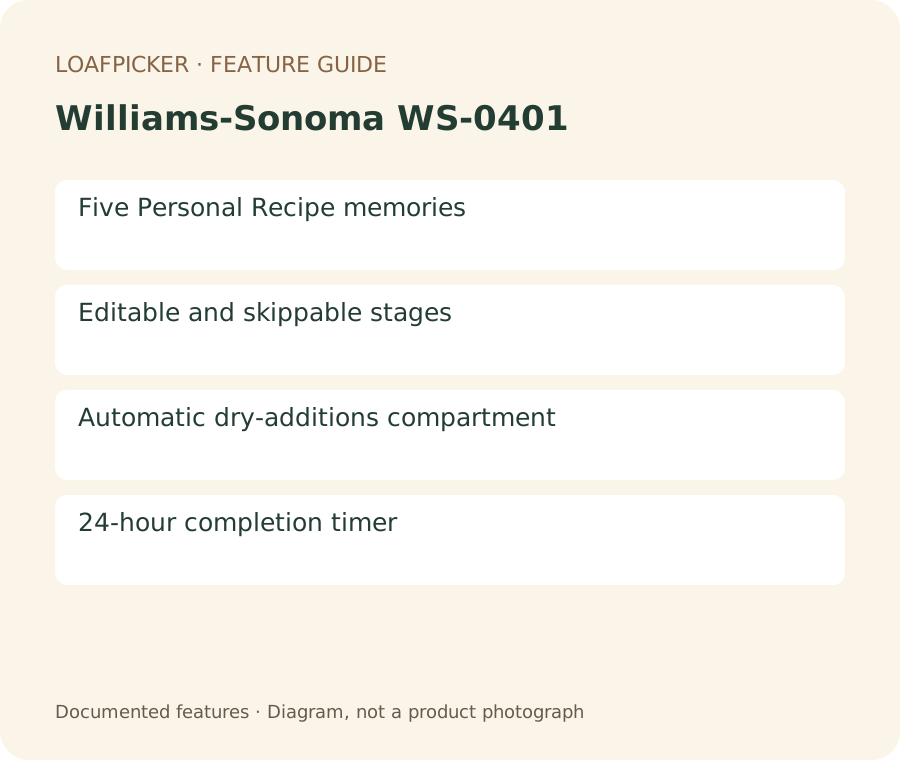
 Original LoafPicker feature diagram. Product references appear below. Not a product photograph.
THE FIT AT A GLANCE
At a glance
Experienced baking with five saved stage sequences, omitted phases and custom-timed dough.
Composite surviving manual requires separating WS-specific sections from generic appendices; current exact parts and electrical ratings unverified.
Shop this model on Amazon ↗Affiliate link · Model search.
The Williams-Sonoma Grande Cuisine WS-0401 has a more substantial reason for an experienced baker to investigate it than its brand name. Its model-specific instructions describe five Personal Recipe memories and the ability to alter individual kneading, rising and baking stages. Combined with an automatic additions compartment and a 24-hour completion timer, that makes it an unusually configurable older breadmaker. The decision still depends on the condition and completeness of the particular machine and on reading its surviving documentation carefully.
The accessible manual copy is a composite document with a WS 0401 cover and Grande Cuisine operating sections, followed by additional recipe material. Some supplementary material is generic or carries other machine identifiers. This review uses the sections that explicitly describe the Grande Cuisine controls. It does not treat every appended recipe or general capacity table as a specification for this model, and it does not claim a practical baking test.
The actual loaf controls stop at two pounds
The operating instructions provide 1, 1½ and 2 lb selections. They describe White, Whole Wheat, French, Fruit & Nut and other programs with variations for size and crust. These explicit controls are better evidence than the generic pan-volume table near the beginning of the composite copy, which discusses machines up to 3 lb. That table should not be read as proof that the WS-0401 can bake a 3 lb loaf.
Choose the amount you eat and the intended formula before valuing the maximum setting. A smaller programmed amount may reduce leftovers, while a larger recipe can serve more people. The size function is not universal: the instructions exclude Quick Bread/Cake, Jam and Pizza Dough from loaf control. Do not assume every program changes in the same way when you select a different weight.
Personal Recipe and Custom Program are real controls
The five Personal Recipe memories let you save your own sequences. The book explicitly describes programming kneading, rises, punch-down, shaping, baking and warming, and setting an unwanted phase to zero to skip it. That goes well beyond interrupting a fixed bread cycle. For a baker adapting a recipe to a particular flour or environment, being able to preserve a sequence can save repeated setup.
Custom Program is described separately as changing the timing of an existing foundation program while retaining its relationships to size and crust. The manual also says that mixing, kneading and proofing times in dough programs can be changed. These are meaningful distinctions: saving a personal sequence and modifying a standard course are different ways to approach the same recipe, so keep a written record of which method you used.
The programming list includes a Temperature step, but the reviewed passages do not establish numerical ranges or independent temperature choices for each rise. Do not expand that label into a promise of unrestricted thermal control. The clearly established benefit is timing control, including the ability to omit stages. A natural starter still requires observation; no exact starter-only recipe or guaranteed automatic fermentation result was established here.
Pause can support hands-on finishing
The manual explains pausing during a program to remove and shape dough, then returning it for the final rise and bake. That can be useful for filled or braided bread when you want the machine’s baking chamber but not an entirely automatic loaf. It also means taking responsibility for the timing and handling of the dough rather than expecting a preset name to perform the shaping.
Dough and Pizza Dough are separate selections. For ordinary dough, the completion signal is a handoff for shaping, another rise when required and conventional oven baking. A configurable machine can reduce mixing work, but the final steps remain part of your schedule. If those hands-on steps are the enjoyable part of breadmaking, this model’s controls are more relevant than a long list of convenience recipes.
The dispenser needs activation and suitable ingredients
The instructions describe loading the additions compartment and using Extras so that Add Extras appears. The stated capacity is half a cup of dry additions; liquids should not be poured into it, and wet pieces need appropriate preparation. A dispenser that is present but stuck, missing its cover or failing to release cannot provide the intended convenience, so inspect its mechanism before buying an older example.
Personal Recipe programming also asks whether additions should be enabled. That supports integrating the release into an editable sequence. However, complete eligibility for every fixed dough program was not established. If automatic additions are essential to your intended recipe, confirm that exact program behavior rather than treating the compartment as a universal feature on every selection.
A long timer does not make every recipe suitable for waiting
The completion timer goes to 24 hours in ten-minute steps. The book excludes Jam from delayed operation and describes using delay with manually programmed cycles. The display represents the time until completion, including the selected cycle. A long planning window can be useful, but it does not extend fermentation automatically or make every ingredient appropriate for a prolonged room-temperature wait.
The manual excludes perishables such as eggs, fresh milk, meat and fish from delayed recipes. Bread can receive a sixty-minute warming hold afterward, while Dough and Jam do not. It also describes sixty-minute power-failure memory. These are documented operating provisions, not a guarantee that an aging machine’s electronics or a particular interrupted recipe will perform perfectly.
Documentation and condition set the buying limits
No dedicated gluten-free course or exact WS-specific gluten-free formula was established. Custom controls may support informed experimentation, but they should not be marketed as an undocumented gluten-free preset. Full electrical ratings, external dimensions, current service arrangements and replacement-part stock were also not established from the reviewed sources.
Check the WS-0401 label, pan, paddle, dispenser and panel against the Grande Cuisine operating sections. The strongest fit is an experienced baker who can use saved stage sequences and assess an older appliance carefully. A buyer seeking a straightforward documented gluten-free workflow or assured replacement parts has unresolved questions to settle first.
Documented specifications
- Model
- WS-0401
- General loaf sizes
- 1 lb, 1.5 lb, 2 lb
- Dedicated GF course
- No
- GF capacity basis
- WS-specific operating menu contains no dedicated GF course; no exact WS-specific GF formula established. Generic appended recipes are not adopted.
- Automatic add-ins
- Yes
- Complete adjustable cycle
- Yes
- Body dimensions
- Not confirmed in the primary sources used here