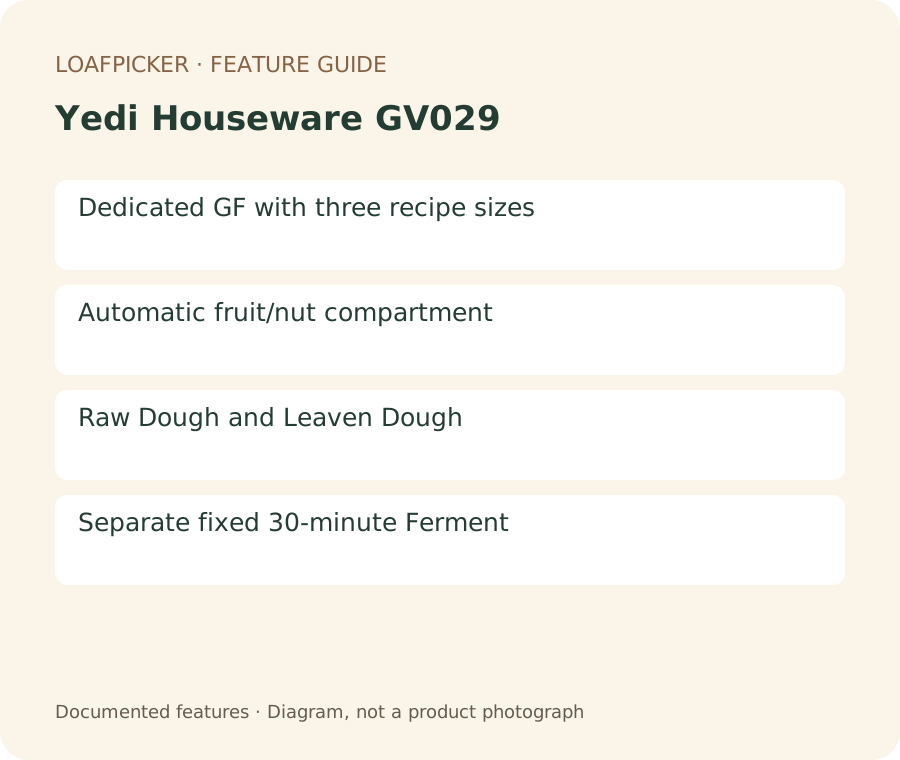
 Original LoafPicker feature diagram. Product references appear below. Not a product photograph.
THE FIT AT A GLANCE
At a glance
Dedicated GF bread at three explicitly documented amounts, conventional bread and separate raw/leavened dough preparation.
Natural Sourdough recipe uses commercial yeast; fixed 30-minute Ferment is not an established adjustable proofing system.
Shop this model on Amazon ↗Affiliate link · Model search.
The Yedi GV029 offers nineteen programs, an automatic additions compartment and dedicated gluten-free controls at 1, 1½ and 2 lb. Its manual is unusually helpful in providing a recipe table for each of those gluten-free amounts. Two other labels deserve more care: Natural Sourdough is a long preset whose printed recipe uses measured yeast, while Ferment is described as a thirty-minute process. Neither label, by itself, establishes a freely adjustable natural-starter workflow.
The manufacturer’s manuals page links a GV029 booklet, and the technical specifications inside explicitly identify item GV029. That original document is the basis of this review. Its illustrated recipe tables were checked rather than relying only on text extraction, which omits some important quantities. No practical baking test or observed service response is claimed.
Three selected bread capacities
The Loaf button selects 1, 1½ or 2 lb for programs 1–9 and Gluten Free, number 16. The default is Soft Bread, Medium crust and 1½ lb. These are genuine control positions. The specification’s additional “1000 g (2LB)” notation should be read as the maker’s nominal labeling, not a mathematically exact conversion or an extra fourth setting.
Size control does not apply to every menu. Dough preparation and several non-bread foods have their own procedures. Choose a suitable recipe amount as well as the correct course. A size button does not balance an improvised formula, and a large pan does not establish permission to exceed the book’s recipe quantities. The manual gives general dry-ingredient limits, but starting with one exact recipe makes the first result easier to interpret.
Gluten-free quantities are explicitly supplied
Gluten Free is menu 16, and the Loaf button expressly works on it. The recipe table includes separate 1, 1½ and 2 lb columns, with an estimated program range of 2:50–3:00. That combination provides stronger evidence of intended size support than a generic maximum-capacity claim. It is not a single fixed-size gluten-free course.
The formula uses gluten-free flour, corn flour, guar gum, eggs and yeast. It does not contain wheat flour in the inspected table. However, the book does not name an exact flour brand or fully specify the composition of its gluten-free blend. Those details matter when reproducing a result: blends differ in starches and binders, and the course name cannot make them interchangeable.
Use the exact table for the selected amount rather than assuming that every quantity scales in a simple ratio. An attended first attempt also helps you see whether the mixture is being incorporated properly. The egg-containing formula should be started immediately. A course’s technical timer eligibility does not make its perishable ingredients suitable for waiting unrefrigerated.
What Natural Sourdough actually documents
Menu 3 is named Natural Sourdough Bread and is given an estimated 6:34–6:49 schedule. Its printed ingredients include water, oil, salt, sugar, milk powder, bread flour and measured yeast. No mature starter quantity or starter-feeding procedure is supplied in that table. A buyer should therefore understand it as the maker’s long yeast-bread preset, rather than an established formula leavened solely by a maintained starter.
A long process can be relevant to flavor and scheduling, but the name does not prove that every starter can follow it automatically. Natural-starter activity changes with feeding, flour and temperature. Without a documented starter formula or adjustable stage sequence, assigning the preset to an arbitrary starter recipe involves experimentation beyond the supplied instructions.
Ferment is separately described as allowing prepared dough to rise for thirty minutes at a preset 86°F. That can be useful for an owner whose recipe needs that treatment. The reviewed manual does not establish an adjustable proofing duration or temperature range for it. Repeating a fixed program is not the same as having a documented full custom cycle, so this machine should not be selected on that assumption.
Dough preparation has two different handoffs
Raw Dough takes an estimated twenty-three minutes; Leaven Dough takes 1:24. Those separate menus let you distinguish a mixing job from dough preparation that includes development toward rising. You still remove the contents and follow the recipe’s remaining shaping, proofing and oven steps. Plan the machine’s completion for a time when you can handle that handoff.
Bake is another separate function, with a manually entered time and three stated color-associated temperatures. It does not establish free temperature programming for each fermentation stage. The presence of Raw Dough, Ferment and Bake gives an owner several tools, but their documented fixed and adjustable elements should remain distinct when assessing how much supervision a recipe needs.
Automatic additions and delay need course-specific confirmation
The removable fruit-and-nut compartment releases its contents when the Fruit indicator and signal occur. The booklet also permits manual additions at that point. Check that the compartment, latch and mounting parts are present in an older example. It is an actual automatic release feature, rather than merely an audible reminder.
The reviewed instructions do not provide a complete menu-by-menu dispenser eligibility table. Do not promise automatic release on every dough, gluten-free or custom workflow based solely on the compartment’s presence. Confirm the exact course you intend to use. This is particularly relevant if unattended additions are the main reason you are considering the appliance.
The delay section explicitly includes programs 1–9, Raw Dough, Leaven Dough, Gluten Free and Sticky Rice. It explains time until completion and excludes dairy products, eggs and similar perishables. A maximum delay duration was not established in the reviewed text, so it should not acquire a generic fifteen-hour figure from a similar machine.
Check the exact appliance and its accessories
The technical table specifies 120 V, 60 Hz and 710 W. A circuit diagram separately marks a 600 W heating element; that is not a replacement for the appliance’s total rating. The accessories list says two stirring paddles are included, but the operating instructions fit one onto a single shaft, so the spare count should not be advertised as dual kneading.
Current exact-part stock, outside dimensions and warranty eligibility for a secondhand purchase were not established. The GV029’s strongest documented case is conventional and gluten-free baking with several selected amounts and optional automatic additions. A need for independently adjustable fermentation or a proven starter-only preset leaves meaningful questions that its program names do not settle.
Documented specifications
- Model
- GV029
- General loaf sizes
- 1 lb, 1.5 lb, 2 lb
- Dedicated GF course
- Yes
- GF capacity basis
- Gluten Free is program 16 and permits 1 lb, 1.5 lb and 2 lb selections. The original recipe has all three corresponding columns, with estimated cycle times of 2:50–3:00.
- Automatic add-ins
- Yes
- Complete adjustable cycle
- No
- Body dimensions
- Not confirmed in the primary sources used here