Former stainless brand page unavailable and exact numeric model/manual unresolved; historical feature claims retained only as attributed context.
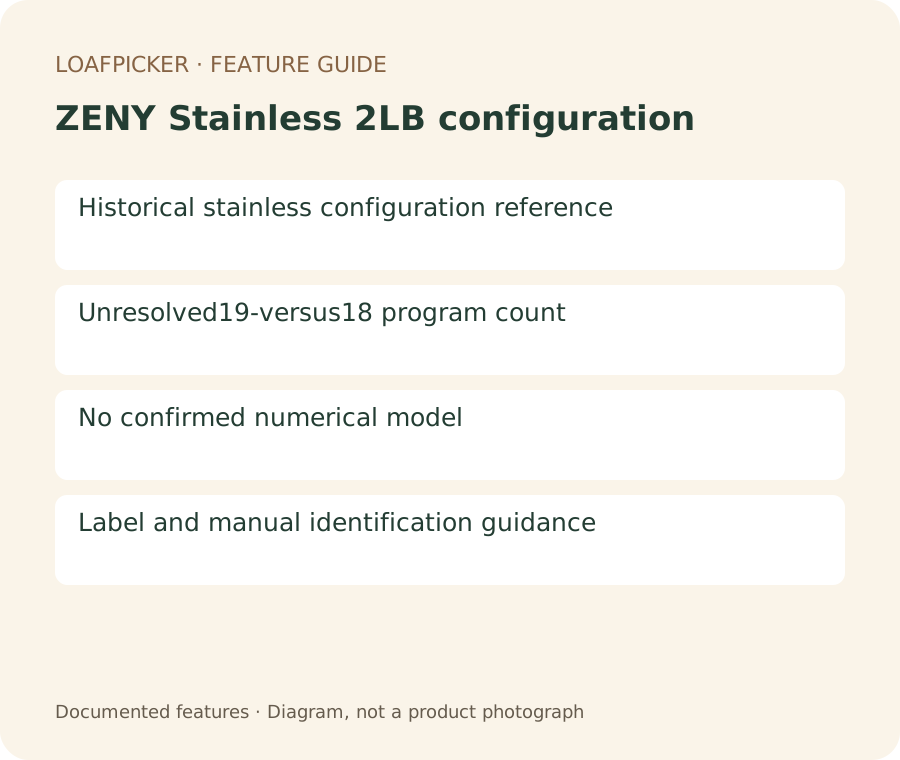 Original LoafPicker feature diagram. Product references appear below. Not a product photograph.
THE FIT AT A GLANCE
At a glance
Identifying an owned or used stainless configuration through its label, panel and supplied instructions.
Historical claims cannot be promoted to confirmed operation; current white-machine instructions do not establish equivalence.
Shop this model on Amazon ↗Affiliate link · Model search.
The stainless ZENY breadmaker formerly described as a Programmable 2LB, 550W machine cannot presently be assessed with the same confidence as a model supported by an obtainable maker manual. Its former brand product address is unavailable, no numerical model code was recovered, and the earlier feature description contains an unresolved program-count mismatch. This page is therefore an identification and ownership reference, rather than a purchase recommendation based on confirmed operating specifications.
That distinction is useful if you already own one or encounter a used example. A recognizable brand and stainless exterior can help locate an older listing, but they do not establish which program instructions belong to the machine. The most valuable next evidence is its own rating label, a clear panel photograph and the instruction book supplied with that exact unit.
What the historical description does—and does not—tell you
An earlier description attributed to the brand page listed 1, 1½ and 2 lb amounts, nineteen programs, a fifteen-hour timer, one-hour warming and fifteen-minute interruption recovery. Those details remain historical claims; the current unavailable page does not allow them to be newly checked. They should not be treated as verified current features simply because several numbers resemble another breadmaker’s specifications.
The earlier description claimed nineteen programs but enumerated only eighteen names. That gap should remain visible. It does not justify inventing a nineteenth course, assuming two names mean the same thing or borrowing a full menu from a visually similar appliance. A panel photograph can establish what is physically printed, while the matching manual is needed to explain how each choice behaves.
The old address includes gluten-free and whole-wheat wording. That is a useful search clue, but it does not supply an exact gluten-free program table, intended flour mixture or size eligibility. A broad product title and an operating instruction are different kinds of evidence. For someone choosing a machine primarily for gluten-free bread, the missing documentation is a practical limitation rather than a minor naming detail.
Keep the stainless and white ZENY machines separate
ZENY also has a white twelve-setting breadmaker page. Its listed capacities and controls should not automatically be transferred to this stainless configuration. Different exterior materials can accompany different programs, components or revisions, and a shared brand does not establish that two products use the same instructions. Even a similar button arrangement would need a model-label connection before exact timings could safely be assigned.
When documenting an owned machine, photograph the entire label without cropping off suffixes, voltage or date information. Then photograph the control panel with every printed menu name visible. Keep any order record or booklet cover with those images. This gives a support agent a concrete identification problem to solve, rather than asking whether ZENY breadmaker instructions in general will work.
Two pounds is not a universal recipe permission
The historical name advertises a two-pound maximum. That does not establish that all programs accept the same amount, that a gluten-free course has selectable sizes or that a dough-only batch has the same limit as a baked loaf. Those questions require exact instructions. Without them, a large-looking pan is not evidence that an oversized recipe is appropriate.
For a used purchase, ask whether the seller can supply a recipe previously used with that machine and the corresponding program instructions. A successful demonstration with one ordinary loaf can show basic operation, but it cannot prove every menu, timer or ingredient-release function. It also does not provide a validated starting point for a different flour system.
Delay, recovery and custom controls remain unresolved
The earlier timer and power-recovery figures lack an obtainable model-specific procedure. It is not established which courses accept delay, what happens after a longer interruption or whether the displayed time means completion or delayed starting. Do not build an overnight routine around an isolated historical number. The intended recipe’s ingredients and the manual’s waiting restrictions matter as much as a maximum timer figure.
Likewise, a list of bread courses would not establish independently adjustable fermentation. A fixed Dough program, if present, could prepare commercial-yeast dough without providing a freely timed natural-starter process. No full custom sequence or independent proofing controls were confirmed for this stainless machine. Those capabilities should remain open questions until the panel and manual explain them.
Inspect the parts that make an older appliance useful
Check that the bread pan and kneading paddle are present, fit correctly and have sound surfaces. The pan’s attachment and shaft seal matter because a replacement with the wrong coupling may look similar while failing to fit. No exact manufacturer parts list or present replacement supply was established, so a seller’s assurance that generic parts are easy to find needs verification.
Stainless steel in the product description does not identify the pan’s coating or establish ceramic construction. It also does not provide dishwasher instructions. Follow only care guidance matched to the actual unit, and obtain that guidance before using an aggressive cleaning method. The condition of a difficult-to-replace pan can be more consequential than the number of functions advertised.
The historical 550W description does not establish the correct voltage and frequency. Read the actual nameplate before connecting the appliance, particularly when the machine has changed countries. A plug shape or an adapter is not evidence of electrical compatibility. Outside dimensions and a verified current service route for this variant were also not recovered.
When the reference becomes useful
For an existing owner, the strongest path forward is to assemble the label, panel and supplied booklet and ask ZENY to identify the exact configuration and compatible parts. For a prospective buyer, obtaining those documents before committing makes the decision concrete. Until that connection is established, this stainless ZENY remains a documented historical listing with unresolved operating details, not a confirmed match for gluten-free, timed dough or custom fermentation requirements.
Documented specifications
- Model code
- Numeric code not confirmed
- Configuration
- Stainless 2LB configuration
- General loaf sizes
- Exact size settings not confirmed
- Dedicated GF course
- Not confirmed
- GF capacity basis
- Former title mentions gluten-free, but no current exact course table, GF quantity or authenticated manual established.
- Automatic add-ins
- Not confirmed
- Complete adjustable cycle
- Not confirmed
- Body dimensions
- Not confirmed in the primary sources used here