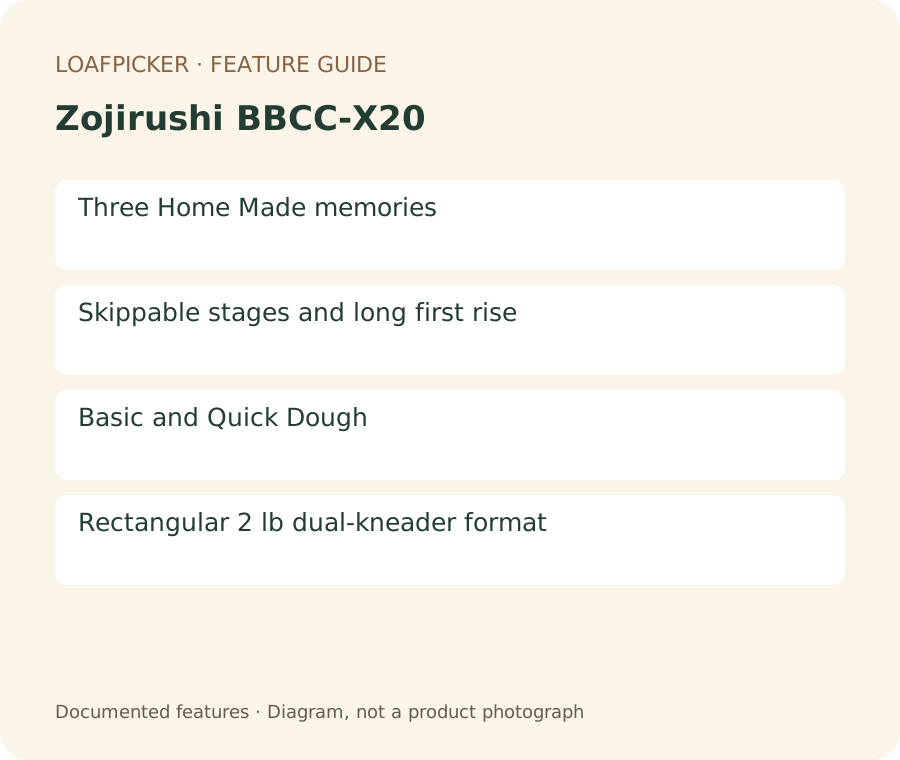
 Original LoafPicker feature diagram. Product references appear below. Not a product photograph.
THE FIT AT A GLANCE
At a glance
Experienced supervised fermentation and ordinary 2 lb bread using three truly editable stage memories.
No dedicated GF preset, no independent small-loaf selector or automatic additions; older parts require exact availability checks.
Shop this model on Amazon ↗Affiliate link · Model search.
The Zojirushi BBCC-X20 Home Bakery Supreme remains interesting as an older machine because its Home Made course provides three saved sequences and substantial control over individual stages. Its ordinary format is a rectangular 2 lb loaf, and it has separate basic and quick dough programs. Its gluten-free support needs a precise description: the maker supplies recipes and custom-course guidance, but this model has no dedicated gluten-free preset.
The original operating booklet explicitly names BBCC-X20, and Zojirushi’s current breadmaker FAQ distinguishes its recipe support from the designated gluten-free courses on other models. That combination is the basis for this review. It does not claim hands-on loaf quality, noise measurements or assurance that a particular used machine remains mechanically sound.
Choose it for the ordinary loaf format you need
The book describes a traditional rectangular 2 lb loaf and shows two kneading blades. It does not provide a separate loaf-weight selector with independent small and large positions. If a smaller daily batch is your main requirement, do not assume that the standard capacity automatically provides several selected sizes. An adapted amount and an independently programmed weight setting are different things.
For a household that uses a larger loaf, the pan format may be attractive. Check both blades and their shafts when assessing an older example, and examine the pan’s surface and seals. Two kneaders create two accessory and shaft areas to inspect; they do not, by themselves, prove better mixing or quieter operation. The condition of the actual appliance is more important than a reputation attached to the model name.
Three Home Made memories provide meaningful control
The Home Made course lets you save three sequences and set the times for preheating, kneading, separate rises and baking. Stages can be switched off, which matters when a recipe should not receive a later knead or repeated rising. The manual also documents a first-rise allowance extending to twenty-four hours. This is substantially more useful for supervised fermentation than merely having fixed Dough and Bake buttons.
That control is still not the same as selecting any temperature you want for every stage. The booklet describes stage temperatures and three crust treatments, but it does not establish a freely entered temperature for each rise. Plan around its actual heating behavior and observe the dough. A long first-rise timer cannot determine when a particular natural starter is ready.
The initial Home Made memories have no baking process programmed. An owner should therefore inspect and deliberately set a complete sequence rather than assume that selecting a memory will produce a familiar loaf. Keep a written copy of the intended times, especially when an older machine may already contain another owner’s saved settings. Start from known settings before judging a recipe.
Gluten-free recipes are not a dedicated course
The menu includes Basic, Basic Wheat, Basic Dough, Quick, Quick Wheat, Quick Dough, Jam, Cake, Sour Dough Starter and Home Made. It contains no Gluten Free selection. Zojirushi’s FAQ specifically places BBCC-X20 among the models supplied with a gluten-free recipe rather than the newer models with a designated course. That distinction should remain visible in any comparison.
The FAQ gives a Home Made approach for gluten-free baking: fifteen minutes of preheat, twenty-five minutes of kneading, the first two rises off, fifty-five minutes for the third rise and fifty-five minutes of baking, with warming optional. Those instructions demonstrate a documented custom workflow. They do not create a new preset or establish a selectable gluten-free loaf-weight control.
The original book includes a brown-rice gluten-free formula, while the FAQ points to further recipes. Use a suitable exact formula alongside its stated sequence instead of treating the custom times as permission to substitute any flour mixture. The reviewed material did not establish a separately selected gluten-free capacity. Ingredient blend, binding system and the intended recipe amount remain necessary parts of a reproducible starting method.
The Sour Dough Starter label also needs interpretation
The booklet’s starter recipes begin with measured active dry yeast. Its Light Sourdough Bread adds further yeast and flavoring ingredients, and its traditional procedure develops the prepared mixture over additional days. These are specific manufacturer recipes, not evidence that the short starter course cultivates a mature wild starter from flour and water in a couple of hours.
For someone already maintaining a natural starter, the relevant advantage is the editable Home Made sequence and its long rise allowance. That supports supervised control without making the booklet’s yeast-started recipe a starter-only formula. The machine cannot remove the need to judge fermentation, adjust the sequence to the dough and select a suitable final baking process.
Dough and timer choices are course specific
Basic Dough is intended for active dry yeast; Quick Dough is the faster preparation using rapid-rise yeast. Both leave you with dough to shape and finish, rather than a baked loaf. The exact recipe directions explain the changes needed when switching to the quick process. Reserve time for those later steps when deciding when the machine should finish.
The thirteen-hour completion timer is limited to Basic, Basic Wheat, Basic Dough and Home Made. Quick Dough is not timer eligible. The maker excludes recipes containing perishables such as milk, juice, vegetables and eggs from delayed use. The timer therefore helps with suitable ordinary dough or custom sequences, but it is not a universal overnight option for every recipe.
Ingredient additions are manual, prompted by a signal on eligible processes. No automatic fruit-and-nut dispenser is documented. If you want a loaf with additions made at a specific point, arrange to be there; a long timer and a saved program do not supply the missing ingredient-release mechanism.
Service evidence and the final decision
The manual specifies 120 V, 60 Hz, with a 600 W heater and 100 W motor. It lists dimensions as 17 × 10 × 12 inches without clearly labeling the axes in the reviewed specification block. Check the real machine’s footprint and lid clearance. Zojirushi still identifies BBCC-X20 in its parts index, but the model entry’s availability status is not a promise that every required part is currently obtainable.
A complete BBCC-X20 is most useful to assess for its 2 lb format, distinct dough processes and genuinely editable stages. Buyers seeking a dedicated gluten-free preset, automatic additions or several independently selected loaf weights should understand its different approach. Its custom controls provide real scope for an attentive baker, provided the pan, blades and electronics are sound.
Documented specifications
- Model
- BBCC-X20
- General loaf sizes
- 2 lb
- Dedicated GF course
- No
- GF capacity basis
- No dedicated GF course. Original brown-rice GF recipe and official FAQ custom sequence documented, but separately labeled GF quantity not established in reviewed passages; no selected/fixed GF capacity inferred.
- Automatic add-ins
- No
- Complete adjustable cycle
- Yes
- Body dimensions
- Not confirmed in the primary sources used here