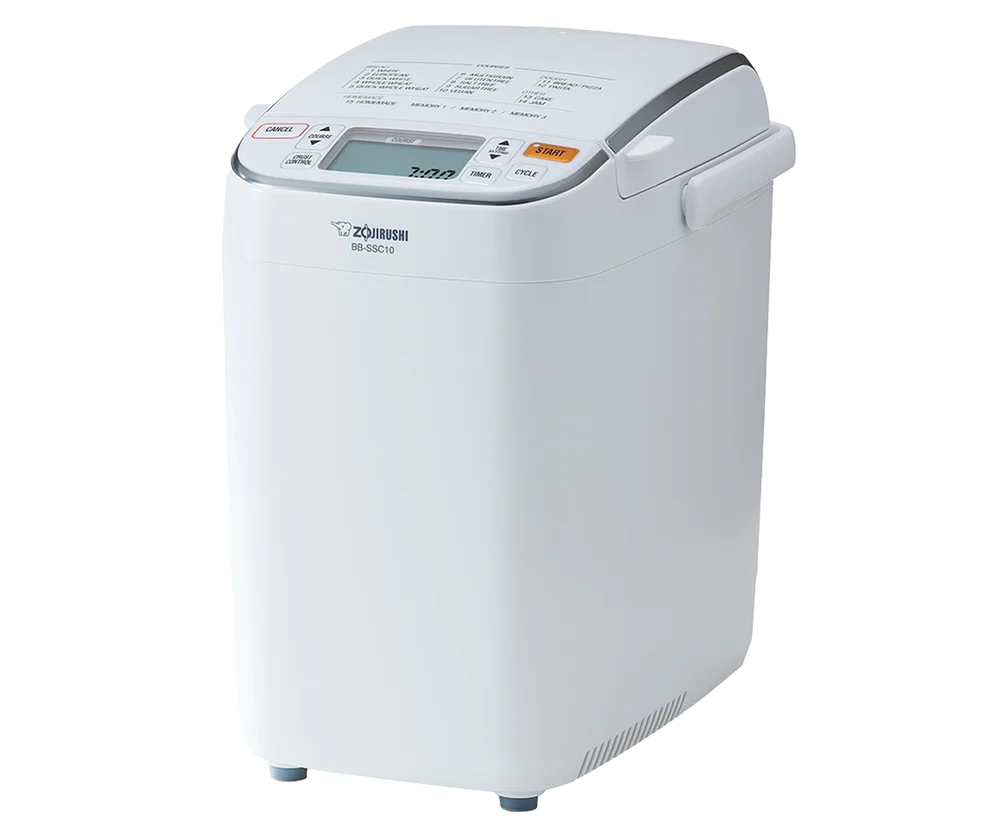
 Zojirushi Maestro BB-SSC10. Product image: Zojirushi.
THE FIT AT A GLANCE
At a glance
Small households that need a 1 lb gluten-free course or an automatic mix-in dispenser.
One-pound capacity gives no larger-loaf option; the upright body still needs lid clearance.
Check price on Amazon ↗Affiliate link · Current retailer offers.
The Maestro is for someone who wants a small loaf without accepting a stripped-down process. It combines a one-pound pan with an automatic add-in dispenser, a dedicated gluten-free course and three Homemade memories. Choose it because one pound suits your routine; its extra controls are most valuable after that capacity decision is right.
Where it fits especially well
- Small households that want fresh bread in manageable batches.
- A dedicated one-pound gluten-free workflow.
- Suitable fruit or nuts added without returning for a signal.
- Experiments in stage timing without moving to a larger pan.
Where it is a compromise
- No larger setting when one loaf regularly falls short.
- A narrow body still needs vertical access to the lid and pan.
- Custom memories are useful only if you want to develop recipes.
A small loaf can be the most useful feature
The easiest way to overbuy a bread machine is to start with the largest capacity you might ever need. The Maestro takes the opposite approach: a one-pound pan is its normal job. For a household that prefers a smaller fresh loaf to several days of leftovers, that can be a better everyday fit than a machine with a wide pan and a small setting added to its menu.
Capacity is still a practical limit. If a loaf disappears in one sitting and you want bread for the next day too, another full cycle is not the same convenience as choosing a larger batch. Think through your weekday consumption, freezer habits and weekend guests before choosing a machine built around this size.
The dispenser changes when you need to be present
The automatic add-in dispenser is a meaningful distinction from the Mini. It releases appropriate ingredients during the course, so a seeded or fruit loaf need not depend on you returning to an ingredient signal. This is especially relevant if breadmaking runs alongside work, family routines or another cooking task.
Follow the manual's rules for ingredients and quantities. An automatic dispenser is a timed container, not a universal solution for every sticky, wet or meltable addition. A recipe may still call for an ingredient to be loaded directly into the pan or handled separately. Cleaning the removable dispenser is part of the next batch's preparation.
One-pound gluten-free is a real point of difference
Here the machine's one-pound format and dedicated GF course fit together. That distinction matters because several larger breadmakers advertise both a small ordinary loaf and a gluten-free course, but do not offer that small size on the GF program.
The CBK-110NAS documents a 1½ lb GF program. The Breville offers 2 and 2½ lb GF choices. Those machines can be useful, but they answer a different capacity request. If you are specifically avoiding large gluten-free batches, the Maestro deserves an early place in your comparison.
Use a matching recipe and consider equipment and ingredient handling separately from the program. A gluten-free course controls a baking sequence; it does not settle cross-contact requirements in a shared kitchen.
From automatic courses to your own schedule
The menu includes everyday bread, whole wheat and multigrain alongside dough, pasta dough, cake and jam. Those courses give a beginner somewhere concrete to start. The three Homemade memories add a route for a baker who later wants to preserve changes to kneading, rising and baking timing.
A useful way to grow into the machine is to make the same plain loaf until you can repeat it, then change one ingredient or stage. Save a program when the result is worth repeating. This is more informative than editing the schedule on the first bake to compensate for an unknown measuring or flour substitution problem.
Kitchen fit: narrow does not mean tiny in every direction
The listed body is 8⅞ inches wide, 12½ inches deep and 13⅝ inches high. The narrow width can be convenient between other appliances, but depth and access above the unit still determine where it can work. Measure the operating position, not merely the cupboard where you plan to store it.
Think about removing the pan, handling hot components and cooling the loaf. If you must move the machine each time, check where it will stand during the cycle. A compact machine is most convenient when the whole process has a home.
Mini, Maestro or a larger model?
Choose the Mini if your intended one-pound recipes fit its simpler controls and the extra automation is not useful to you. Choose the Maestro when GF, automatic add-ins or saved timing resolves a specific need. If you regularly want a larger loaf, compare a larger machine directly instead of treating either one-pound model as an occasional family-size solution.
The focused Mini-versus-Maestro comparison helps separate the shared capacity from the features you would actually use. Your current retailer's offer can then settle the price difference; the feature decision should come first.
A first-week routine for this machine
- Start with the manufacturer's one-pound basic recipe and record the course and weights.
- Try a supported add-in recipe if the dispenser influenced your purchase.
- Keep GF ingredients, utensils and handling appropriate to your needs.
- Use the dough course for an oven project before editing an entire Homemade schedule.
This sequence lets you learn the pan, signals and recipe collection before adding more variables. It also tells you whether the small batch really fits the way you eat.
Can it make a larger loaf?
It is a one-pound machine. Choose a larger documented capacity if that is a regular requirement.
Does it have a dedicated gluten-free course?
Yes, as part of its one-pound workflow. Use an appropriate recipe for that course.
What does it add over the Mini?
The main differences for this comparison are its dedicated GF course, automatic add-in dispenser and three saved Homemade timing programs.
Documented specifications
- Model
- BB-SSC10
- General loaf sizes
- 1 lb
- Dedicated GF course
- Yes
- GF capacity basis
- Dedicated 1 lb machine and recipes
- Automatic add-ins
- Yes
- Complete adjustable cycle
- Yes
- Body dimensions
- 8.875 × 12.5 × 13.625 in (W × D × H)
Before you order
- Match recipes to the 1 lb pan rather than a generic 2 lb breadmaker recipe.
- Check the full open-lid space; the listed 13⅝-inch height is body height only.
- Use the dedicated gluten-free recipes rather than treating wheat recipes as substitutions.