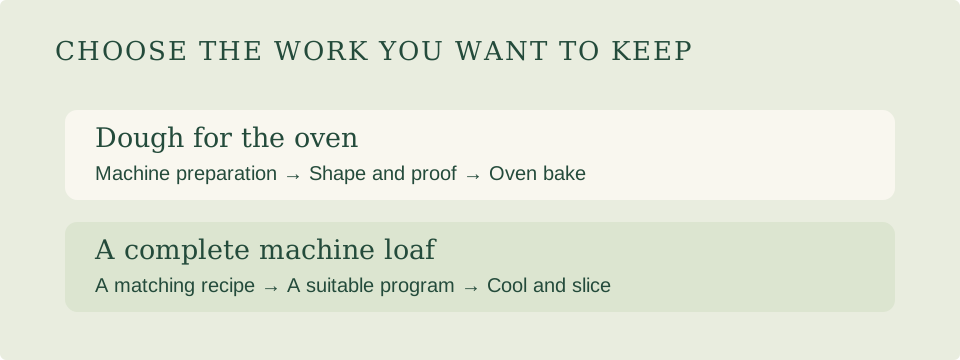
Choose a sourdough workflow before choosing a bread machine. Mixing dough, preparing a starter mixture and finishing a naturally leavened loaf are separate tasks. The right controls depend on which job you want the machine to take over.
Route one: use the machine for mixing
If you enjoy shaping a loaf and baking in an oven, a machine can handle part of the preparation. You then manage fermentation, shaping, proofing and the final bake according to the recipe. This route preserves the shapes and crust methods you want while moving some mixing work into an appliance.
Check how the dough program runs and where it stops. A fixed dough schedule may not finish at the moment your natural-starter dough is ready. Separate kneading and rising tasks, such as those on the SD-R2550, can suit a baker who prefers to move deliberately between stages.
Route two: use an adjustable complete cycle
If you want the machine to bake as well, editable stages offer another approach. The Virtuoso Plus, Maestro, Breville and Hi-Rise provide different versions of custom-cycle control.
Choose the pan size first, then inspect the stages you need to adjust. A saved sequence can make a developed recipe repeatable, but your starter's activity and the dough's readiness still matter. An adjustable clock is a tool for your judgment, not a substitute for it.
Route three: follow a yeast-assisted automatic recipe
Some sourdough recipes use both starter and commercial yeast. That can fit a programmed schedule while giving you a different process from bread raised only by your established starter. Read the formula before deciding that a program name promises natural-starter-only bread.
The Panasonic SD-R2550 manual is a concrete example: it separates a starter stage and a bread stage, and its bread formula includes instant yeast. That is a supported recipe route if it fits your goal. Choose a supervised approach if commercial yeast is outside the process you want.
What does a starter course actually do?
A starter course may assist an initial mixture or fermentation step. It should be read alongside the manufacturer's recipe and instructions. Its presence does not describe every later step, nor does it establish a complete automatic loaf from an arbitrary natural starter.
Before purchasing, write down whether you will bring an established starter, make the supplied starter mixture or use a yeast-assisted recipe. This single decision often clarifies which controls are useful and which menu labels are beside the point.
Choose controls by the decisions you want to make
| Your preferred involvement | Control to inspect |
|---|---|
| Mix, then handle dough myself | Dough or a separate manual kneading task |
| Choose when fermentation ends | Manual rising or adjustable timing |
| Repeat a developed in-machine loaf | A complete custom cycle and any saved memories |
| Follow a documented automatic formula | The exact recipe, ingredients and supported program |
A practical development sequence
- Choose a formula within the machine's mixing and pan capacity.
- Know whether the loaf is yeast-assisted or naturally leavened.
- Record starter condition, ingredient weights and the process used.
- Observe dough readiness at the stages the method requires.
- Change one clear part of the process, then preserve a successful routine.
The baking log keeps recipe and timing notes together. The finder treats natural-starter projects as a supervised workflow and compares machines with adjustable or separate manual tasks. You can then require a complete custom cycle if that is how you prefer to work.