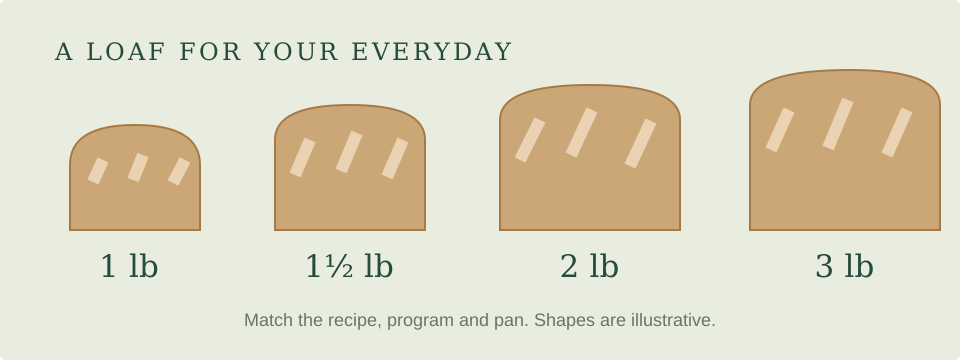
Choose the batch you will use most often, then check that the intended program supports it. A small household does not automatically need a small machine, and a large capacity is useful only if the extra bread has a purpose.
Start with what happens after baking
Think of the last loaf you bought. Did you finish it fresh, freeze part of it, or throw away the end? That answer is a better starting point than the maximum size printed on an appliance. A one-pound loaf can suit someone who likes to bake fresh more often. A larger loaf can suit someone who slices and freezes promptly.
A household count is only a guide. Two people making daily sandwiches may use more bread than a larger household that eats an occasional piece of toast. Our finder uses household and storage habits as preferences; an exact capacity becomes a requirement only when you select it.
A useful map of the size choices
| What you want | Models worth comparing | Important detail |
|---|---|---|
| A machine built around 1 lb | Mini and Maestro | One pound is the normal pan format, not a smaller setting in a large pan. |
| Several ordinary sizes | Cuisinart, Artisan and Breville | Read the selected course; GF may offer a different range. |
| A horizontal 2 lb loaf | Virtuoso Plus | A focused capacity and pan arrangement. |
| 2–3 lb batches | West Bend Hi-Rise | Two pounds is the smallest documented setting. |
| Manufacturer-labeled M/L/XL recipes | Panasonic SD-R2550 | Use its own recipe quantities; do not equate flour weight with baked-loaf weight. |
Capacity, recipe yield and a size button are different
A fixed-capacity machine gives you a pan and recipe collection organized around that size. A size selector lets a program use an intended schedule for one of several batches. A recipe yield tells you what that formula is intended to produce, even if there is no corresponding size control on the course.
This distinction is especially important for GF bread. The CBK-110NAS lists a 1½ lb GF program. Breville's GF choices are 2 and 2½ lb. Hamilton Beach's Artisan guide provides GF recipe examples without the ordinary size selector. Those are different routes to a loaf, not interchangeable labels.
Can you simply halve a larger recipe?
A smaller batch must still meet the paddles and pan as the machine was designed to use them. Reducing ingredient quantities does not change the pan's surface area or the distance between kneading blades. A very small amount of dough in a wide pan may be a different mixing job from the one the recipe assumes.
Begin with a model-specific formula in the size you need. If you want to adapt another recipe, use a reliable conversion guide and respect the machine's mixing and rising limits. Do not solve an oversized loaf by guessing at half a recipe on the first bake.
Shape changes how a loaf fits your meals
A tall pan and a horizontal pan can produce differently shaped slices even at a similar finished weight. If the shape of your usual sandwich matters, include pan format in the comparison. The appliance's outer width is useful for the counter; it is not a published measurement of the slices.
Make a decision you can repeat
- Choose whether you prefer frequent small loaves or planned larger batches.
- Pick the bread style and find a compatible recipe.
- Check the size on that exact program.
- Measure the machine's working position.
- Plan how any extra slices will be stored.
Use the finder for a small-batch or larger-batch shortlist. If you already know an exact weight, add it in the optional final step. For a larger batch, the storage guide helps turn capacity into a useful routine.
References
- Zojirushi Maestro product information ↗
- Zojirushi Mini specifications ↗
- Zojirushi Virtuoso Plus specifications ↗
- Custom Loaf instruction book, US/Canada ↗
- CBK-110NAS instruction and recipe booklet ↗
- Hamilton Beach 29985/29987 use and care guide ↗
- Panasonic SD-R2550 US/Canada instruction book ↗
- West Bend 47413 instruction manual ↗