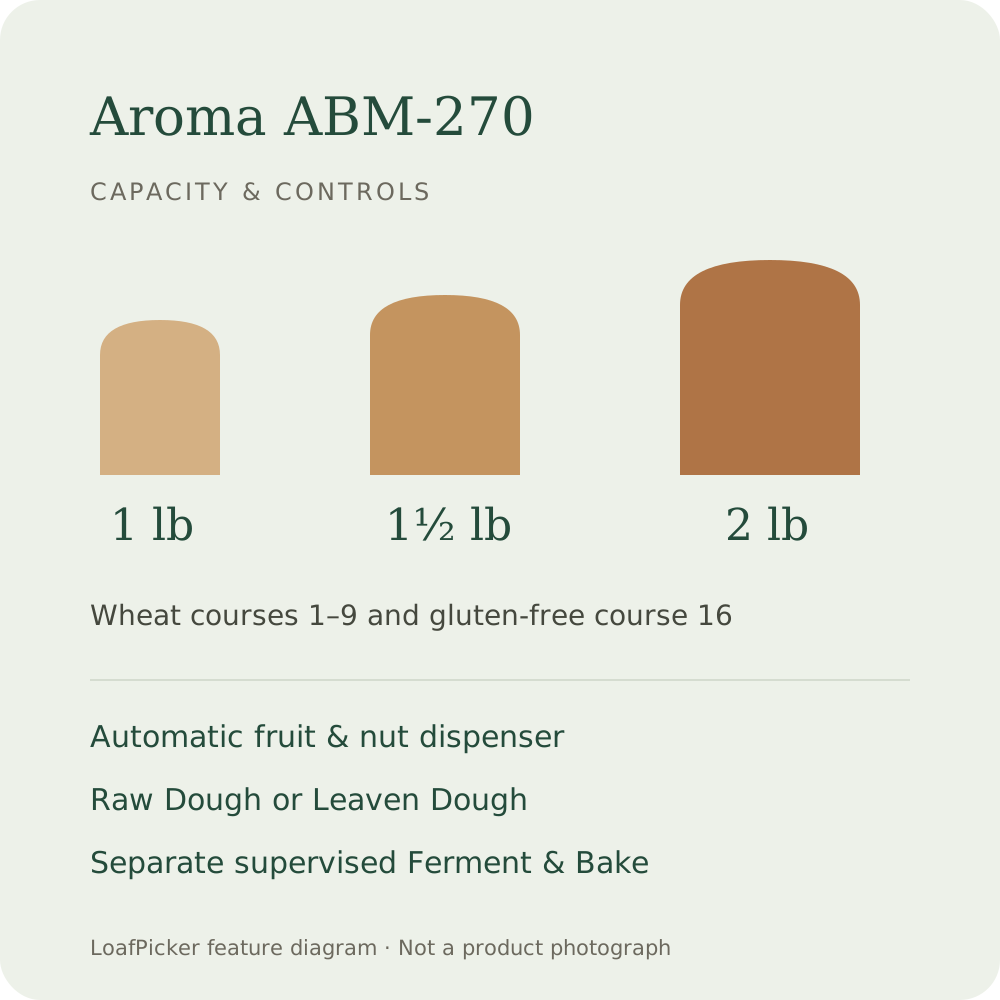
 Original LoafPicker feature diagram, based on the ABM-270 manual. Not a product photograph.
THE FIT AT A GLANCE
At a glance
Bakers who want small or family-size loaves, a dispenser and separate supervised dough stages.
Separate Ferment and Bake functions require intervention; they are not saved complete custom programs.
Shop this model on Amazon ↗Affiliate link · Model search.
The Aroma ABM-270 suits a household whose bread routine changes: a smaller fresh loaf on one day, a larger batch on another, and occasional dough or fermentation tasks. Its automatic fruit-and-nut dispenser is useful when the selected course supports it. The important distinction is how those functions work together, rather than the headline count of seventeen programs.
A machine for more than one household routine
The ABM-270 offers one-, one-and-a-half- and two-pound selections on eligible bread programs. That range is useful if weekday consumption and weekend demand differ. You can choose a formula for the smaller fresh batch or deliberately make more to portion and freeze. Start with the recipe corresponding to the course and size, rather than pressing a smaller setting on a larger mixture.
This flexibility is the clearest reason to compare it with the ABM-250. The smaller Aroma model concentrates on one and one-and-a-half pounds and has a particularly short Ultra Fast option. The ABM-270 adds a two-pound choice and a different collection of programs. Neither product number should be treated as a simple size upgrade with otherwise identical controls.
When the automatic dispenser is valuable
A dispenser makes the most difference when a recipe calls for additions after mixing has begun and you will be elsewhere. The ABM-270 releases suitable add-ins on functions 1–9, 12 and 16. Its presence does not mean it opens during every task. Check your chosen function before planning a fruit-and-nut loaf around an unattended start.
Think of the dispenser as removing one scheduled visit, rather than making all ingredient preparation automatic. Ingredients still need measuring and loading, and an unfamiliar formula benefits from your attention during its first attempts. If you mostly make plain bread, this convenience may rarely matter. If you routinely miss an add-in signal, it could be the function that makes the machine fit your day.
Use the dough and fermentation controls deliberately
Raw Dough, Leaven Dough and Ferment serve different stages. Raw Dough mixes and kneads without a rise; Leaven Dough includes rising; Ferment is a separate rise-only operation. This separation is useful for someone who wants help with part of a recipe while keeping decisions about readiness and oven baking. It is less relevant to a shopper who wants every loaf completed entirely in the pan.
The Ferment function adjusts from ten minutes to four hours at the manual's stated 86°F. That gives a particular operating range, not a universal schedule for every dough. A natural-starter recipe, especially, requires judging the dough rather than assuming the end of a timer proves fermentation is complete. The booklet's Sourdough formula includes commercial yeast. Its named program therefore should not be treated as proof of a completely unattended natural-starter-only loaf.
Gluten-free, multigrain and other specific choices
Gluten-Free, Whole Wheat, Sugar-Free, Multigrain and Soft Bread are named functions. Choose between them using the actual formula and intended result. A special program name does not authorize arbitrary ingredient substitutions, and a gluten-free setting does not address cross-contact requirements by itself. Our gluten-free guide separates those questions.
The manual explicitly permits the size control on Gluten-Free function 16 and provides one-, one-and-a-half- and two-pound GF formulas. That makes this model relevant when a small GF batch and automatic additions are both important. Use the matching formula for the selected size; the setting alone does not scale an unrelated recipe.
Planning bread around your day
The timer reaches fifteen hours on functions 1–9, 11, 12 and 16. Size, crust and dispenser controls each have their own eligibility. Before committing to an overnight routine, write down the exact course, formula and functions involved. That is more useful than deciding that a machine with a timer can delay every recipe.
Ingredients impose another limit: the manual cautions against delayed use with perishables. The Yogurt function has a separate adjustable five-to-thirteen-hour schedule, while a one-hour Keep Warm period follows eligible finished tasks. These are different operations. Keeping a finished loaf warm is not the same as extending fermentation, delaying the start or storing bread until the next day.
Checks that matter before buying
Match the offer to ABM-270, confirm the dispenser and other included parts, and check the appliance's measured footprint if space is tight. The reviewed manual does not establish body dimensions or wattage, and its description of a nonstick pan does not identify the coating as ceramic. Those are specific questions for the seller or manufacturer, rather than features to infer from stainless-steel housing.
For a dedicated one-pound loaf with saved custom cycles, compare the Maestro. For a larger horizontal loaf with adjustable complete cycles, compare the West Bend Hi-Rise. The ABM-270 earns its place when changing batch sizes, timed additions and separate dough tasks are the conveniences you will actually use.
A useful first comparison
List the two recipes you expect to make most often. Check their batch sizes, whether additions are automatic on their courses, and whether their ingredients permit delay. If both routines work, the extra programs can remain optional rather than becoming a reason to complicate everyday baking.
Documented specifications
- Model
- ABM-270
- General loaf sizes
- 1 lb, 1.5 lb, 2 lb
- Dedicated GF course
- Yes
- GF capacity basis
- GF function 16 has 1 / 1½ / 2 lb settings and matching manual recipes
- Automatic add-ins
- Yes
- Complete adjustable cycle
- No
- Body dimensions
- Not confirmed in the primary sources used here
Before you order
- Size selection applies to functions 1–9 and 16, not every task in the menu.
- The Sourdough recipe includes commercial yeast; use a supervised process for natural-starter-only bread.
- A permitted timer setting does not make a recipe containing perishable ingredients suitable for delay.
- The manual specifies a 120 V AC supply; check the exact unit before ordering.