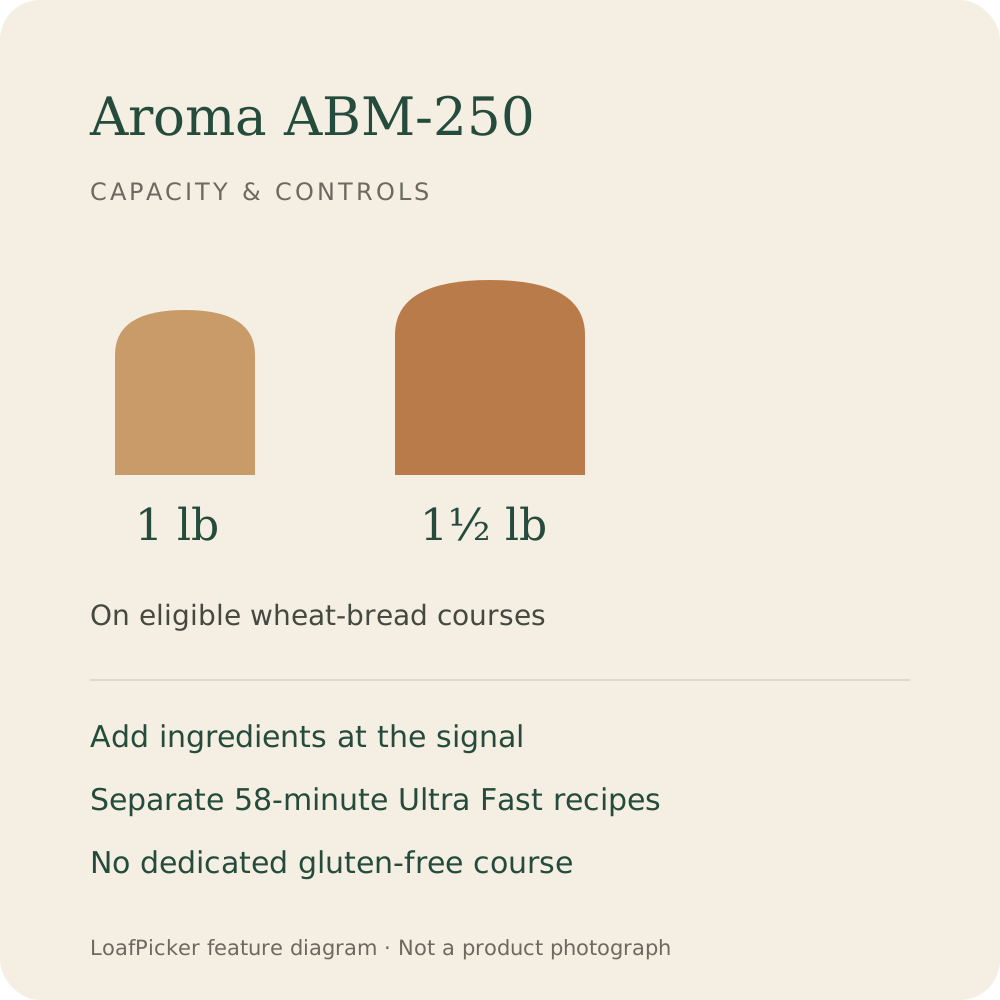
 Original LoafPicker feature diagram, based on the ABM-250 manual. Not a product photograph.
THE FIT AT A GLANCE
At a glance
Smaller households that want a wheat-bread preset and can return for add-ins.
The largest documented size is 1½ lb; no dedicated GF course or automatic dispenser.
Shop this model on Amazon ↗Affiliate link · Model search.
The Aroma ABM-250 is worth considering when the useful loaf is the one you can finish, rather than the largest loaf a machine can make. Its 1 lb and 1½ lb choices suit a smaller bread routine, while the 58-minute Ultra Fast settings offer a distinct convenience. Choose it for those jobs, rather than for automatic add-ins or a dedicated gluten-free program.
Start with how quickly your household finishes bread
Imagine making bread for two people who mostly eat toast at breakfast. A large loaf might spend several days on the counter, or require a plan for freezing half of it. The ABM-250's smaller recipe sizes make that decision easier. Its ordinary size selection covers White, French, Whole Wheat, Sweet and Soft Bread. You can develop a familiar recipe at the size you actually use instead of treating unused capacity as an advantage.
The size button is not a recipe-scaling tool. Pick the corresponding formula and course, then keep the ingredients in proportion. Aroma identifies the 1½ lb setting as the route to its most conventional loaf shape. A one-pound choice is useful for quantity, but should not be understood as an identical loaf with a few slices removed. Our capacity guide explains why the pan and recipe belong in the same decision.
What the fast settings change
Ultra Fast has separate one-pound and one-and-a-half-pound choices, each with a chart time of 58 minutes. That makes the ABM-250 relevant when a short cycle is a real requirement. Aroma also describes a coarser result than its Quick Bread function. The practical choice is therefore between a particular fast formula and the longer routine you normally prefer, rather than between identical bread delivered at different speeds.
For an ordinary baking day, begin with a standard course. Establish what a successful batch looks like before using speed as the main variable. For the Ultra Fast route, follow Aroma's instructions for that formula and ingredient temperature. A very short program is a poor place to improvise flour, yeast and liquid at the same time. If your goal is breakfast bread, a suitable delayed ordinary cycle may fit your day better than starting the fastest cycle after waking.
Programs that earn their place
Whole Wheat, Dough, Jam, Cake and Yogurt give this small-loaf machine jobs beyond a basic white loaf. Dough is particularly useful if you want the machine to handle mixing and rising while you shape rolls or pizza for the oven. It changes the division of work: you still decide the final shape, proof and bake. Someone who already likes that part of baking may get more value from Dough than from a longer list of automatic bread names.
Yogurt has an adjustable six-to-twelve-hour operation, so it occupies the machine on a very different schedule. Consider whether that use complements your bread routine. A machine that spends the afternoon on another kitchen task cannot also be preparing that evening's loaf. This is a scheduling consideration, not a reason to count every extra function as either essential or useless.
Where you still need to be involved
Add-ins are a return-to-the-kitchen task. The ABM-250 gives a signal for suitable fruit or nuts; it does not have an automatic dispenser. If you plan to put the machine on and leave the house, decide whether you can use a recipe without that later addition. If you usually remain nearby, the manual step may be a small inconvenience and a useful opportunity to observe a new recipe.
Delay eligibility also varies. Ultra Fast, Jam, Cake, Bake and Yogurt are excluded. The manual does not establish a maximum timer range, so a specific overnight deadline needs checking rather than borrowing a number from another Aroma machine. Delayed recipes also need to comply with the ingredient guidance. Milk, eggs and other perishable ingredients are a separate issue from whether the panel lets you select a timer.
Who should choose a different machine
A dedicated gluten-free course is not part of this model's menu. If that course is essential, compare the Zojirushi Maestro, particularly for a small loaf, or the Aroma ABM-270 for a broader size range. A reference to gluten-free flour in an ingredient discussion does not give the ABM-250 the same workflow.
The ABM-270 is also the more relevant Aroma comparison when an automatic dispenser or a two-pound choice matters. Conversely, those features have little value if you consistently want a small, plain loaf and are present during mixing. Before buying an ABM-250 offer, confirm its exact model, pan and paddle, and measure the actual appliance if counter fit is restrictive; the reviewed manufacturer book does not provide body dimensions.
The choice in one sentence
Keep the ABM-250 on your list for small everyday batches and a genuinely short, specifically prescribed fast cycle; choose a different model when unattended additions, dedicated gluten-free baking or a larger family loaf define the job.
Documented specifications
- Model
- ABM-250
- General loaf sizes
- 1 lb, 1.5 lb
- Dedicated GF course
- No
- GF capacity basis
- No dedicated gluten-free course
- Automatic add-ins
- No
- Complete adjustable cycle
- No
- Body dimensions
- Not confirmed in the primary sources used here
Before you order
- The size control works on functions 1–3, 5 and 11; Ultra Fast has its own fixed-size courses.
- The 58-minute recipes use their own method; Aroma describes the result as coarser than Quick Bread.
- The manual specifies a 120 V AC supply. Confirm the rating label on the particular machine.