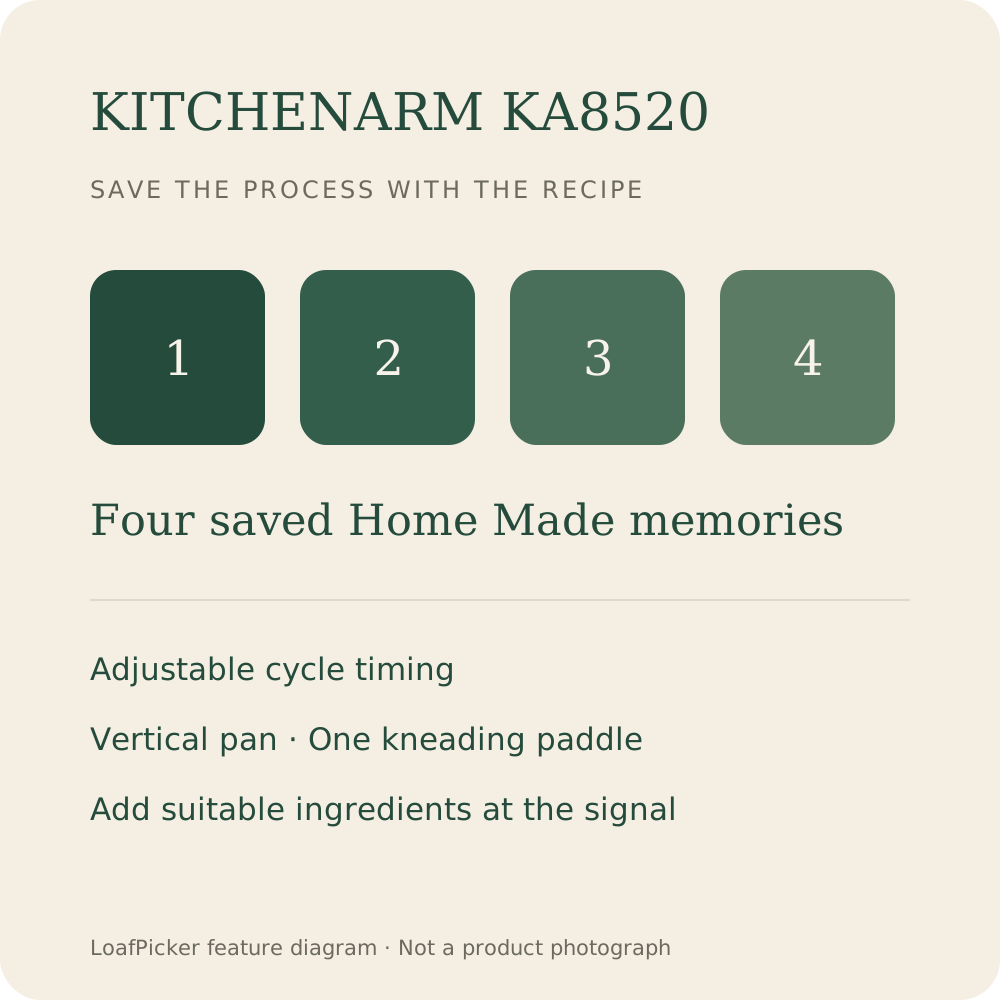
 Original LoafPicker feature diagram, based on the KA8520 manual. Not a product photograph.
THE FIT AT A GLANCE
At a glance
Recipe developers who want saved stage timing and a vertical pan.
Manual additions are documented; automatic dispensing, exact GF weight and body dimensions are unconfirmed.
Shop this model on Amazon ↗Affiliate link · Model search.
The KITCHENARM KA8520 is an option for a baker who wants to develop recipes and return to saved timing choices. Four Home Made memories are more relevant to that person than the headline twenty-nine-menu count. Its vertical pan, manual additions and program-specific controls create clear tradeoffs for someone who mainly wants a straightforward unattended loaf.
Buy the model whose instructions you understand
KA8520 is the model named in the manufacturer quick guide and the corresponding operating manual. Other KITCHENARM numbers appear in retailer descriptions and old catalog records. Similar branding or an overlapping program count is not enough to transfer every specification. Confirm KA8520 on the appliance or the exact offer before applying this review.
The manual is also a useful pre-purchase test of complexity. Look at the normal sequence for the first recipe you want to bake, and at the Home Made controls if customization is your reason for buying. If both routines feel manageable, the range can be useful. If the first loaf already seems unnecessarily involved, a simpler preset-based machine may fit your habits better.
Four memories are the main control advantage
Home Made provides four saved selections with adjustable stage durations. That lets you associate different timing plans with particular formulas. Keep a note of the ingredients and purpose beside each saved sequence; a memory number by itself is easy to forget. The baking log can keep those details on your device.
Timing control is not evidence of unrestricted temperature editing. Nor does saving a long fermentation schedule establish that the dough will be ready at a fixed time every day. Recipe development still involves ingredient measurement and judging the dough. For a natural-starter project, the useful role is a supervised process whose stages you can adjust, rather than an automatic guarantee for an unfamiliar starter.
Read the specialty names as different processes
The menu separates Express White, Quick Bread and Cake. Dough, Pasta, SD Starter, Sourdough, Ferment, Knead and Bake are also distinct tasks. That is useful if the machine will prepare part of a meal while you manage shaping, further fermentation or oven baking. Decide where you want the appliance's work to finish before choosing the course.
Names such as Keto, Salt Free and Sugar Free describe programs and associated recipe intentions. They do not calculate the nutritional result of any mixture you load. Similarly, a recipe service described as being in the cloud does not establish that the machine itself connects to Wi-Fi or an app. The buying decision should follow functions in the exact operating instructions.
Choose capacity on the intended program
Eligible menus use one-, one-and-a-half- and two-pound loaf settings. Several specialty and non-loaf tasks exclude size selection, while Home Made uses that control to choose a memory. A button that looks like the ordinary loaf-size control can therefore serve a different purpose on another program. Keep the recipe, menu and control sequence together.
Gluten Free is a named program, but the retained matching evidence does not establish a verified finished weight for its complete formula. Our finder can consider it for a broad dedicated-GF request, while an exact GF weight requires a model with that capacity confirmed. The ABM-270 has documented GF size choices; the Maestro is built around a one-pound recipe system.
Manual additions and timer restrictions
The instructions use an ADD signal for ingredients you put in by hand. An automatic hopper is not established in the reviewed evidence, so it does not qualify for a required-dispenser answer. If your preferred routine includes leaving during mixing, check whether the recipe needs a later addition. Plain bread may make that missing convenience irrelevant.
The completion timer reaches fifteen hours on eligible courses and excludes a substantial group of specialty tasks. Perishable ingredients impose another restriction. Read the exact menu's instructions before setting up an overnight bake; a timer specification does not make every menu or formula suitable. One-hour Keep Warm is a later holding period, not extra proofing time or a substitute for cooling.
Care and a sensible learning sequence
The manufacturer's compatible replacement pan is described as aluminum with a nonstick Teflon coating and a single paddle. It is a vertical design, and the manual excludes the pan and accessories from the dishwasher and dish-dryer. Confirm the correct replacement part rather than treating any similar-looking bread pan as compatible. If particular coating or cleaning requirements drive your purchase, these details matter before the menu count.
Use the US manual's 120 V, 60 Hz requirements to check the offered unit, and measure its body and working clearances if space is limited. Begin with a normal documented recipe, keep a record, then change one stage for a clear reason. The KA8520 makes most sense when saved timing and separate preparation tasks will support that learning process. A baker who wants automatic additions or only a basic first loaf may reasonably prefer a different balance of controls.
Documented specifications
- Model
- KA8520
- General loaf sizes
- 1 lb, 1.5 lb, 2 lb
- Dedicated GF course
- Yes
- GF capacity basis
- Dedicated GF menu documented; exact finished GF recipe weight not confirmed
- Automatic add-ins
- Not confirmed
- Complete adjustable cycle
- Yes
- Body dimensions
- Not confirmed in the primary sources used here
Before you order
- Confirm KA8520 on the offered machine; other KITCHENARM codes are not automatic aliases.
- Four saved timing memories do not establish unrestricted stage temperature editing.
- The US manual specifies 120 V / 60 Hz and excludes the pan and accessories from dishwashing.